Try our novelties and bestsellers!»






Aesthetic cosmetology, Cosmetic treatments
LLLT low energy laser therapy
Nov
Light therapies are widely used in aesthetic medicine and cosmetology, with an important area of application being regenerative therapies with low-energy radiation.
Sources of radiation can be varied, but laser therapies, which are referred to as low-energy laser therapies (Low-Level Laser Therapy: LLLT), are gaining particular recognition. Their action is mainly based on the non-thermal action of red light or infrared radiation on tissues resulting in a modification of the biological activity of the tissue.
LASER LLLT in medical and dermo aesthetic therapies
Medical applications of laser therapy include reducing pain and inflammation, as well as promoting tissue regeneration. LLLT is also increasingly used in aesthetic therapies to assist anti-wrinkle therapies, as well as for skin with photo-ageing symptoms in a process called photo-rejuvenation (Avici et al. 2013; Wasylewski, Filo 2017). Although there is still no complete consensus on the mechanism of photobiostimulation, it is believed that red light and infrared radiation are absorbed by chromophores contained in mitochondria, and in particular by cytochrome c oxidase, an important respiratory chain enzyme. This results in an increase in the rate of cell proliferation, as well as an activation of intracellular metabolism. Increased levels of growth factors such as TGFb and bFGF and inhibitors of metalloproteinases such as TIMP have been observed in numerous studies. Growth factors have an activating effect on cells, while TIMP inhibitors reduce the activity of extracellular matrix metalloproteinases such as MMP-1 and MMP-2 resulting in a decrease in the rate of collagen degradation. At the same time, an increase in collagen production is observed.
Laser repair effect
The mechanism of these changes may be related to the activation of repair processes in the tissue, which is associated with increased levels of pro-inflammatory cytokines such as IL-1b and TNF-a. Despite the athermal effect of low-energy light, and therefore the absence of skin damage, similar repair processes are activated as in wound healing. In a clinical study involving 300 patients, light with a wavelength of 590 nm was used and an improvement in skin texture, reduction in roughness and fine wrinkles was observed in 90% of participants (Weiss et al. 2005).
Antibacterial properties of laser light
Other possible applications of low-energy light therapy – for example, acne therapies – are also indicated. Sunlight is known to have a beneficial effect on this dermatosis, and even stronger effects are found with red and blue light. The mechanism of action of light in acne vulgaris is the absorption of radiation by the porphyrins produced by P. acnes. Light reacts with these substances to generate active oxygen species that inhibit bacterial growth. Photodynamic therapy has an analogous mechanism; however, a photosensitising substance is applied to the skin and, in interaction with light, generates active oxygen species (Kohl et al. 2010).
Phototherapies and laser therapies in cosmetology
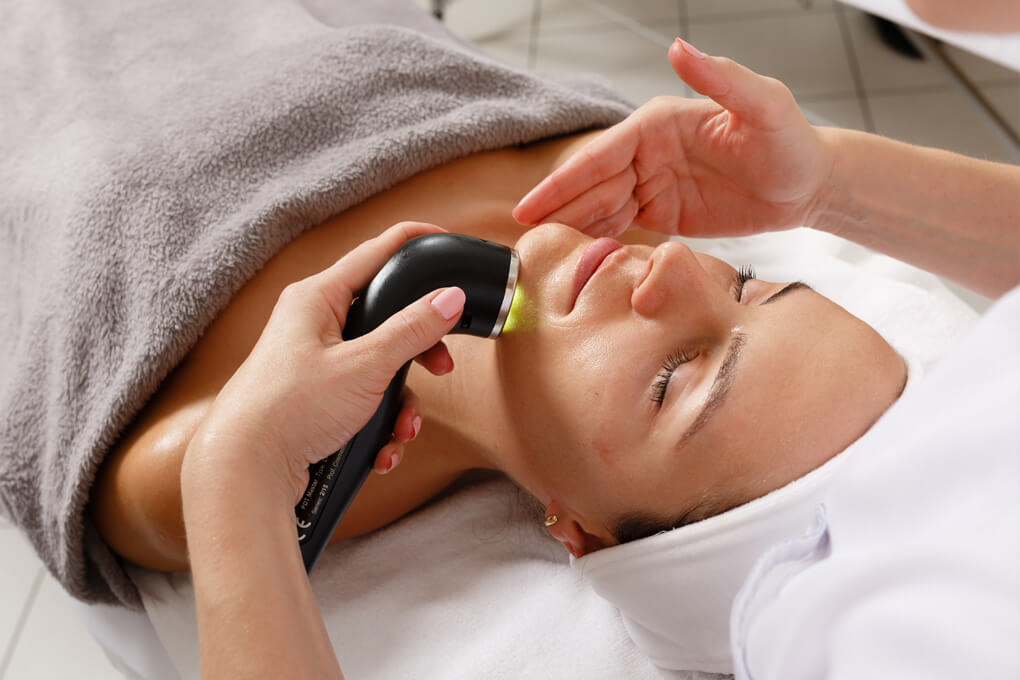
Low-energy light phototherapy has a variety of applications accelerating tissue regeneration and reconstruction and, in cosmetological applications, improving skin condition and appearance. This reconstruction, which takes place at a cellular level, produces a noticeable rejuvenating effect and does not require convalescence as there is no tissue damage. This makes low-energy light treatments a safe and effective option for patients who are unwilling or unable to undergo long convalescence as with ablative procedures. The Chantarelle brand’s range of devices PDT Master® and Photo-Dynamiq® are low energy LLLT lasers with a magnetic field. They have no thermal effect and do not damage tissue. Their action is based on the initiation of biochemical reactions in cells. Thanks to the precise synergy of laser light of a given wavelength and chromophores, a dedicated composition of active ingredients is introduced directly into the problem area and a therapeutic effect is induced.
 Dr Marcin Wasylewski
Chantarelle expert, biotechnologist and university lecturer
Literature:
- Avci, P., Gupta, A., Sadasivam, M., Vecchio, D., Pam, Z., Pam, N., & Hamblin, M. R. (2013, March). Low-level laser (light) therapy (LLLT) in skin: stimulating, healing, restoring. In Seminars in cutaneous medicine and surgery (Vol. 32, No. 1, p. 41). NIH Public Access.
- Kohl, E., Torezan, L. A. R., Landthaler, M., & Szeimies, R. M. (2010). Aesthetic effects of topical photodynamic therapy. Journal of the European Academy of Dermatology and Venereology, 24(11), 1261-1269.
- Wasylewski M, Filo K (2018) Application of low-energy light sources in skin rejuvenation therapies. (2018). Aesthetic Cosmetology, 2(18), 131-133.
- Weiss RA, McDaniel DH, Geronemus RG, et al. Clinical experience with light-emitting diode (LED) photomodulation. Dermatol Surg. 2005;31:1199-1205.