Try our novelties and bestsellers!»






Dermatology, Tips
Skin ageing process
Oct
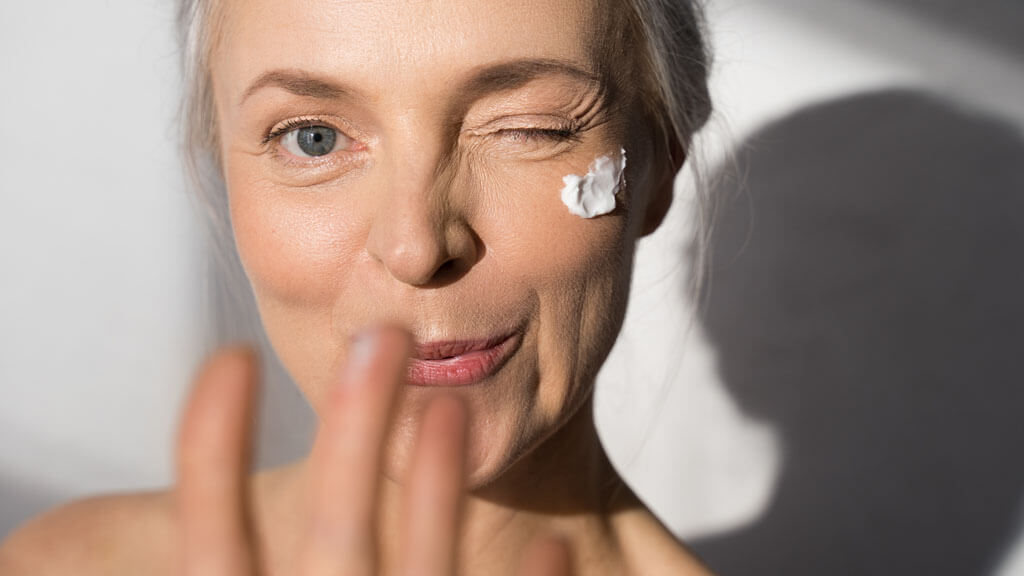
The first visible sign of skin ageing is dryness and loss of elasticity. In the initial stage, microscopic wrinkles develop due to the decreasing amount of water in the dermis and epidermis, gradually causing deeper wrinkles and disruption of collagen and elastin production. Skin ageing occurs simultaneously in all skin layers, even if the initially visible deterioration of the skin concerns only the epidermis, skin tone and skin hydration. Over time, typical changes such as seborrhoeic warts, hemangiomas or pigment disorders become visible on the skin.
How the epidermis ages
Within the epidermis, thinning of the living layers occurs, caused by reduced keranocyte proliferation. The functions of keratinisation and epidermal lipid conversion remain normal, but the process is much slower, which is associated with a visible deterioration of the skin. There is also an increase in the thickness of the stratum corneum and a slower exfoliation process within the epidermis due to the absence of proteinases responsible for the breakdown of corneosomes. There is a slow decrease in the number of melanocytes and Langerhans cells, making the skin less protected against UV radiation and a reduced immune response to allergens. With age, from puberty onwards, the amount of sebum secretion also decreases, making the epidermis dry, the composition of the hydrolipid barrier also changes, as well as the pH becoming more acidic, causing less resistance to microorganisms.
How the dermis ages
Most of the negative changes are rooted in the changing structure and physiology of the dermis. In particular, there is a decrease in the number of fibroblasts and a reduction in their size, as well as a thinning of elastic fibres. In turn, a decrease in the number of macrophages leads to a lack of collagenase and proteinases capable of digesting cross-linked collagen. Collagen fibres become fragmented over time, making them less elastic and resistant to injury. Changes also occur in the chemical composition of the proteoglycan gel – there is a loss of hyaluronic acid, leading to a reduced ability to bind water.
Gravitational changes in the skin
As we age, the dermal-epidermal boundary flattens. There is a progressive irreversible loss of cytoplasmic protrusions of basal layer keratinocytes in the dermis. A reduction in the adhesion of the epidermis to the dermis and a concomitant reduction in the tension of the facial muscles results in the formation of so-called gravitational folds. These changes are most troublesome especially around the chin, mouth, eyes and shoulders. Clinical cases require the intervention of an aesthetic physician or dermatologist, depending on the aetiology of the phenomenon. Poorly fixed, stretched, inflexible skin gives the impression of significant excess and is often reduced by lifting procedures or surgical lifting. However, the majority of cases can be managed without a scalpel and troublesome health complications through the use of cosmetic procedures.
How wrinkles form
Wrinkles are, by definition, folds and deformations of the skin that occur during the ageing process. Initially, lines or fine, shallow scratches are formed, which gradually deepen and become wrinkles. Generally, with thin, delicate skin, such changes already show themselves around the age of 25. With oily complexions, these changes are invisible even up to the age of 50, after which few but deep wrinkles appear. There are also cases of ladies in their 70s with only a few wrinkles on their faces. An ally here is undoubtedly genetic factors, over which we do not yet have sufficient influence. However, even without genetic engineering, ageing processes can be delayed very significantly and effectively. What is important is both prevention, proper and consistent care over many years, and proactive action in the event of a significant deterioration of the skin’s condition (for example, the appearance of many new wrinkles after summer). Decisive action is then needed.
Wrinkle types
For diagnostic and therapeutic purposes, wrinkles are divided into:
Mimic wrinkles – i.e. those that are difficult to influence by any means, as they result from the repetition of specific movements over many years, which cannot be completely eliminated in the future. However, it is possible to significantly improve the condition of the skin in order to pay out mimic wrinkles.
Gravity wrinkles – formed over a lifetime as a result of the physical properties of the earth’s attraction, difficult to reduce. However, skin improvement is possible by both professional cosmetic and surgical means.
Sun wrinkles – are in the main field of interest of aesthetic cosmetics and skin care, generally reversible by specialised methods, arising from the harmful effects of UV radiation and the presence of free radicals in the skin.
Sleep wrinkles – caused by the creasing of the skin during sleep, they straighten out spontaneously several minutes after waking up, generally do not cause cosmetic defects, unless regular crushing of the skin in a certain area causes the formation of a permanent wrinkle.
Factors that accelerate ageing
The ageing process is influenced by a number of factors, which we can divide into three basic categories:
1) genetic factors – a process of cell death programmed by evolution that depends on gene activity,
2) external factors – primarily UV radiation (so-called photoaging of the skin), environmental pollution, care that is not adapted to the needs of the skin, ionising radiation (e.g. from computers), excess ozone, pollutants in the air, exhaust fumes, cigarette smoke and microorganisms.
3) internal factors – related to endocrine disruption, unhygienic lifestyle and vitamin deficiencies, poor diet and smoking.
Holistic rejuvenation
In order for anti-wrinkle and rejuvenation dermoconditioning of mature skin to be as effective as possible, we need to carry out a detailed interview regarding the client’s habits and genetic tendencies. If the main damaging factor is an unhygienic lifestyle, we can try to persuade the client to change behaviours that damage the skin, whereas if the causes lie elsewhere, which is usually the case, we can only suggest a visit to a relevant specialist and make the client aware of the importance of acting in multiple ways.
Rejuvenating cosmetic treatments
The skin ageing process is irreversible, but it is possible to make it happen more slowly, to support the collagen and elastin production processes, to improve the exfoliation of the top layer of the epidermis, to use cell stimulators that act on fibroblasts and tightening agents. A multi-faceted action is needed to achieve satisfactory results, taking into account in-office treatments and systematic home care. Among the treatments, exfoliation with lactic acid or glycolic acid is recommended so as to exfoliate dead epidermal cells, increase its permeability and prepare it for further treatment. Exfoliation can also be replaced by microdermabrasion and, if hyperpigmentation is present, it is best to use depigmenting kojic acid.
The next stage of the programme for mature skin will be, depending on the condition of the skin – either deep nourishment with the ESTRINI 50+ treatment or the moisturising-peptide treatment NUTRI MAXX, which are designed to have a two-pronged effect – to provide nourishment and moisturising for mature skin, but also to improve skin tone and elasticity.