Try our novelties and bestsellers!»





Skin care at home, Aesthetic cosmetology
Cleansing – the first commandment in skin care
Oct
The most common skincare mistake? Lack of or inadequate make-up removal. Skin that has not been cleansed in the evening is deprived of the possibility of nightly regeneration. Sleep is the time when our skin needs to rest and active ingredients are better distributed. During sleep, fibroblast activity and the production of elastic fibres and collagen in the skin increase. Under the cover of darkness, the skin cells destroy old elastin fibres and ‘used collagen’ and produce new ones. At the same time, keratinisation, the continuous exfoliation of keranocytes, which turn into dead cells, or corneocytes, takes place in the skin. The whole process of keratinisation takes about two weeks, but for it to proceed properly the skin must rest overnight from harmful external conditions and other irritants.
When do we forget to remove our make-up?
Make-up removal is done in the evening and in the morning this activity is called cleansing. These are ironclad rules for beautiful and healthy skin. What happens when make-up is left on the face all night? Most foundations and fluids contain irritating ingredients, such as: silicones, dyes or strong preservatives. Make-up gradually “wears off” during the day, but some of the particles of “coloured cosmetics” remain on the epidermal surface. During the day, the skin is also loaded with excess sebum, sweat, keratinised epidermis and other impurities. This clogs the pores, disrupts the composition of the water-lipid layer and the pH level of the skin. This promotes the formation of unsightly blackheads and imperfections. Irritation with small red bumps is also common. Unclean skin is also a difficult barrier to penetrate for the nutrients contained in night-time cosmetics.
he skin cleansing process
Impurities on the skin’s surface are mainly excess sebum, exfoliated corneocytes, dust, sweat components, bacteria and their metabolic products and other components (including make-up residues). To remove these, cosmetics containing so-called surfactants (SPCs) should be used. These substances form so-called spherical micelles in which hydrophobic (lipophilic) particles adhere to each other, leaving hydrophilic heads on the outside of the micelles.

- Hydrophobicity – the property of molecules to repel water molecules from each other.
- Hydrophilicity – the tendency of molecules to combine with water molecules. Hydrophilic is e.g. sweat, water-soluble mascara.
- Lipophilicity – the tendency of molecules to dissolve in fats and oils. Lipophilic are e.g. sebum, waterproof mascara, eye shadow.
Surfactants act on a variety of skin soils. Lipophilic elements combine with dirt of fat and oil origin and can therefore be rinsed off the skin with water. However, the surfactants in the cosmetic are not inert to the skin. When washing away dirt, several chemical phenomena occur that alter the composition of the skin’s hydrolipid mantle and the natural acidic pH that protects the skin from bacteria. As surfactants contain lipophilic elements, this means that they form chemical bonds with fatty substances and thus contribute to the leaching of lipids from the skin’s lipid barrier and stratum corneum. This, in turn, accelerates TEWL, or transepidermal water loss, and contributes to skin dryness. A bit perversely, we can quote the adage – “frequent washing shortens life” – because excessive leaching of lipids from the skin and exposure to washing agents with an alkaline pH has a detrimental effect on the skin, its protective abilities and bacterial flora. Unfavourable effects of SPCs are also observed in their impact on corneocytes and enzymes present in the stratum corneum, often causing irritation and allergic or even inflammatory reactions. In addition, each skin type has its own specific needs and requires a different type of cleanser. Dry skin has a different composition of the water-lipid mantle, while oily skin has a different one. Sensitive skin, vascular skin and skin with acne vulgaris or rosacea also have problems with frequent irritation and an unstable hydrolipidic and bacterial balance on the skin’s surface.
Preparations for cleansing
The most popular cleansers are soaps. They come in the form of bars or in liquid form. Their reaction is always alkaline – i.e. above a pH of 8.5. Soaps are very effective in removing dirt particles, but their irritating properties and strong degreasing action mean that they are not recommended for facial skin cleansing. Combo (from combination bar), or combination preparations, have surfactants in their composition in addition to soaps. Their pH is less alkaline (7.5-8) and they tolerate hard water better. They remove impurities well, but their pH will also not be suitable for all skin types. Combo can be in gel, liquid or bar form. Syndets are state-of-the-art cleansers and can come in any form – liquids, gels, emulsions and any pH. They contain substances of synthetic origin and do not contain soaps. Their advantage is their very high efficacy, disadvantage is their price and their degreasing effect on some chemical systems. Modern syndets also contain incorporated agents of natural origin. Facial skin cleansing products also come in the form of gels or emulsions, or milks. The CHANTARELLE brand has developed the active formulas of these products so that they not only cleanse, but also act on the problems of the skin type in question. They do not contain soaps or irritants and their pH is adapted to the skin type in question.
Purifying gels
The gels are usually based on active ingredients of plant origin and are often designed to wash out oily and combination skin, but Chantarelle also offers a gel for sensitive skin:
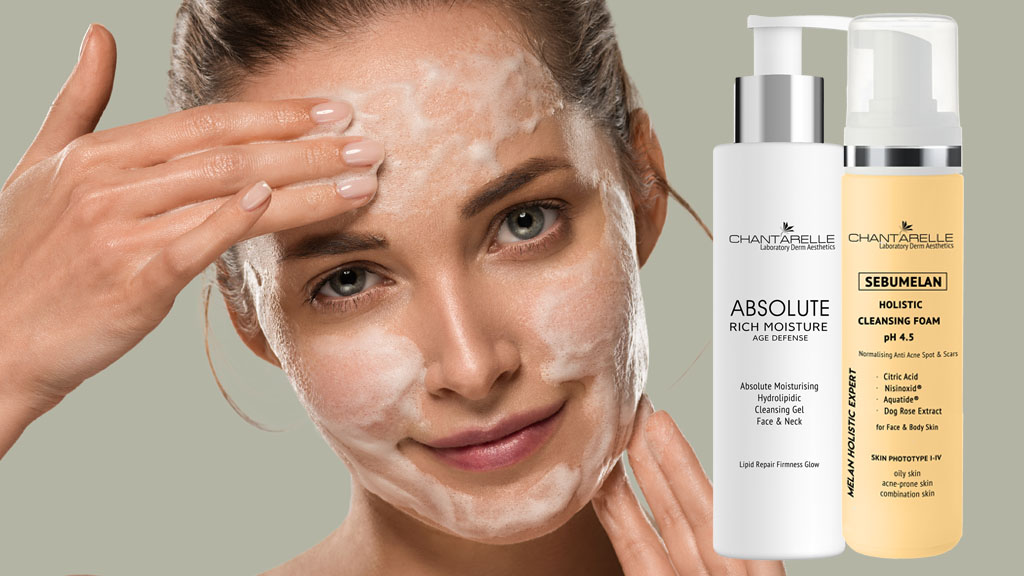
- Absolute Rich Moisture hydrolipidic cleansing gel – absolute hydration – gently washes away skin impurities, intensely moisturises and regenerates the hydrolipidic barrier.
- Sensitive Smart Inflabiome Cleansing gel for sensitive skin, rejuvenating and soothing pH 4.5 – soothing and rejuvenating cleansing gel pH 4.5 against inflammatory ageing and redness, regenerating the microbiome, for face and neck sensitive skin.
- Ideal Pure antibacterial herbal cleansing gel – for oily, acne-prone skin. Perfectly cleanses the skin and eliminates excess sebum, reduces blackheads, tightens dilated pores, moisturises and soothes. It has an antibacterial and astringent effect.
- Ideal Pure lotion with salicylic acid and gluconolactone – for oily skin prone to acne vulgaris. Reduces unfavourable acne-causing bacterial flora, reduces blackheads and signs of inflammation.
- Special Aesthetics AHA Saponaria 11% pH 4.0 – a cleanser that purifies excess sebum, thoroughly washes away impurities, gently exfoliates and moisturises for oily skin, acne-prone skin and predominantly oily mixed skin.
Purifying milks
Chantarelle brand milks are emulsions of the oil-in-water type (O/W, in which each oil molecule is surrounded by water) and, thanks to this formulation layout, the risk of skin irritation from cleansing agents can be reduced while the active ingredients are better utilised.
- Agemelan Holistic milk pH 4.5 brightening and rejuvenating milk for skin with hyperpigmentation. Slows down the skin ageing process and reduces hyperpigmentation.
- Regenevia DNA algae and antioxidant milk. Thoroughly cleanses skin, moisturises and smooths. Replenishes natural antioxidant levels.
- Red Stop anti-redness milk – for removing make-up from vascular skin with symptoms of rosacea. Contains natural plant ingredients. Has a moisturising, soothing and calming effect, improves blood circulation and blood vessel tightness.
- Special Aesthetics ultra gentle cleansing milk with extracts of mallow, plantain, sage, burdock and aloe vera. Designed for make-up removal for all skin types, including sensitive, vascular, dry skin.
- Special Aesthetics eye make-up remover, also from waterproof mascara, with the consistency of a milk. Also suitable for the most sensitive skin under the eyes and eyelids.
Refreshing tonics
The pH scale is used to distinguish between acid and alkaline reactions and contains values ranging from 0 to 14:
- pH = 7 – neutral reaction
- pH > 7 – alkaline reaction
- pH < 7 – acid reaction

The skin has a natural acid reaction and its natural pH varies between 4.5 and 6.6 and is dependent on age, gender, diet. A slightly acidic pH gives the skin protection against bacteria and harmful external factors. The lactic acid and its salts (lactates) present in sweat, as well as the skin’s natural bacterial flora and the unsaturated fatty acids contained in sebum, are responsible for maintaining this pH. Often, we have problems maintaining the acid reaction and this is when the action of tonics is helpful. They restore the skin’s natural pH after cleansing with milk or gel and support the hydro-lipid barrier. Chantarelle tonics do not contain alcohol so as not to irritate the skin. They are also rich in many active ingredients that have a moisturising, smoothing and regenerating effect. They sometimes come in the form of a mist.
- Absolute Rich Moisture toning mist for face, body and hair – absolute hydration – a light and refreshing formulation with a delicate fragrance. Brings immediate relief to dry skin, strengthens its hydrolipidic barrier and restores the correct pH.
- Sensitive Smart Inflabiome toning peptide mist pH 4.5 for sensitive skin, anti-stress and soothing – against redness and inflammatory ageing, rejuvenating, regenerating the microbiome.
- Agemelan Holistic pH 4.5 brightening and rejuvenating tonic for blemished skin – brightening and rejuvenating pH 4.5 tonic with holistic regenerative and protective effects.
- Regenevia DNA AGE anti-glycation, antioxidant toning mist. Regenerates collagen structure reversing the effects of glycation. In addition, it strengthens the elasticity and firmness of the skin.
- Sebumelan Holistic pH 4.5 tonic to normalise and lighten post-inflammatory hyperpigmentation and scars. Provides maintenance of the correct pH for strengthening the protective action of the hydro-lipid barrier against bacteria.
- Ideal Pure herbal, antibacterial tonic – for oily skin prone to acne vulgaris. Restores the skin’s neutral pH. Has an astringent and antibacterial effect. Stabilises the lipid mantle of the skin, normalises the water-lipid balance.
- Red Stop anti-redness tonic – with bio-mineral complex for vascular skin with symptoms of rosacea. Has a relaxing and calming effect. Restores isotonic balance, proper hydration and mineralisation of the skin.
- Special Aesthetics soothing ultra-gentle toner – with hamamelis extract and aloe vera. Designed to tone and cleanse all skin types, including sensitive, vascular, dry skin.
Professional cleansing products
The cleansing products include professional preparations used to prepare the skin for treatments at the beauty salon, such as acid-based peels, mesotherapy or laser therapy. Before treatment with acids, it is most important to degrease the skin so that the acid molecules can penetrate the skin as well as possible. The composition of such a preparation includes natural saponins, or so-called natural soaps. After the completion of the acid-based treatment, it is very important for the beautician to apply a neutraliser, which restores the skin to its previous state and accelerates the restoration of the water-lipid barrier.
How to perform make-up removal and skin cleansing
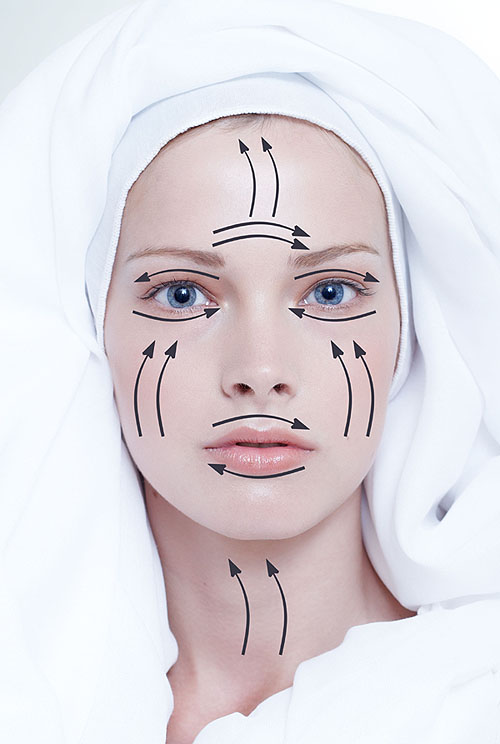 Makeup removal should be done very gently. Start from around the eyes, then the mouth and only then the whole face, neck and décolleté.
Eye make-up removal Soak a cotton pad in make-up remover and place it on the closed eyelid, then press very lightly in a pulsating motion to dissolve mascara and eye shadow. Remove in a downward motion. Repeat until the pad is clean. Once the eye is open, blot mascara from the lower lashes from the outer to the inner corner of the eye.
lip make-up removal Place a cotton pad soaked in make-up remover on closed lips and press lightly. Wait a moment, then remove the lipstick from the lower and upper lips. Repeat until the pad is clean.
Demake-up for the face, neck and décolleté. Apply a small amount of lotion or gel to the palm of your hand (the product will be slightly warmed). It is then spread in circular motions, stroking the skin on the décolleté, neck and face. The product is then washed off with warm water using a make-up remover wipe, sponges or cotton pads. Try not to pull the skin, using movements similar to gentle touching. Make-up is removed until the cotton pads are clean. The diagram shows the direction of the cleansing massage.
Toning After removing the milk or gel, the skin is obligatorily toned. Soak a cotton pad in tonic and wash the décolleté, neck and face from the chin through the cheeks, nose to the forehead.
You should use both lotions, toners and creams from the same skincare line. This ensures that the active substances contained in each preparation do not clash with each other and will not cause effects not foreseen by the manufacturer of the line. Cosmetic series are designed so that the use of cosmetics at the cleansing, toning and active care stage (mask, cream, serum or concentrate) contain active ingredients that act synergistically and consistently.