Try our novelties and bestsellers!»






Active ingredients in cosmetics
Burdock – plants in cosmetics
Aug
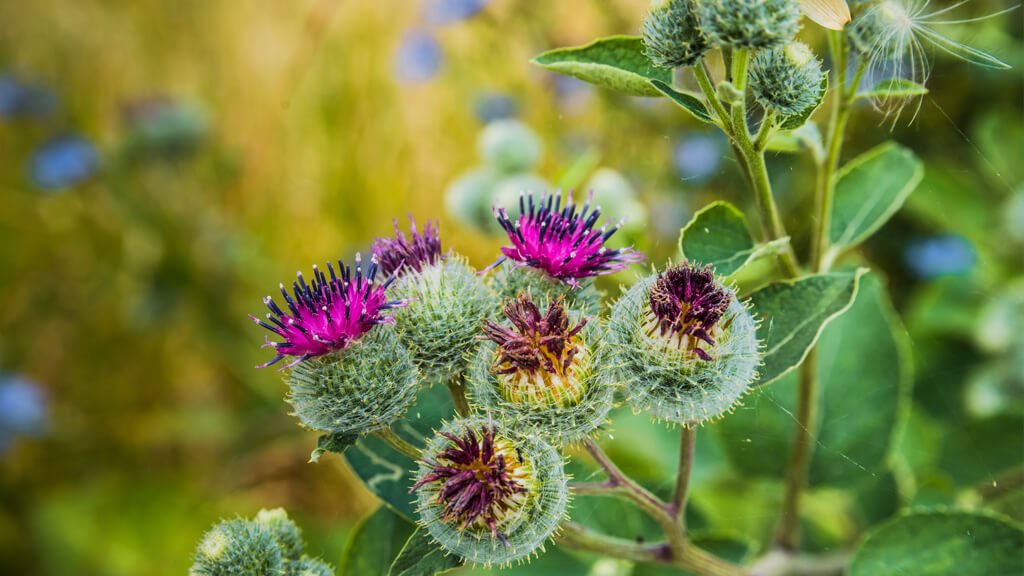
Burdock greater (Arctium majus), also known colloquially as turnip, swollen, hawthorn, fescue, toadflax, gum. It is an annual or perennial plant belonging to the compound family. It grows up to 2 m in height. It has large leaves with wavy edges, 50 cm long, and red or purple flowers. The fruit is a small nut bearing numerous hooked spines that attach to animal hair and clothing. Hence the saying “attaches like a turnip’s tail“. Burdock is found in Europe, northern Asia and the USA. It usually grows along roadsides, riverbanks, and mountain slopes.
Burdock root does not contain starch. It stores carbohydrates in the form of inulin which makes up 30-50% of the whole root. Other active constituents include polyacetylenic and acetylenic compounds containing sulphur, unsaturated compounds (polyenes and polyenes), phenolic acids, tannins, essential oil, potassium salts, mucilage, flavonoids.
Blade in medicine
In the Middle Ages, burdock was used to purify the blood. Its name comes from the Greek word arktos “hairy” and lappa “to attach”. The Iroquois Indians dried burdock roots by the fire and gathered them for the winter. In Asia, it is grown as a vegetable. In England, a refreshing drink called Dandelion and burdock is made from burdock root and dandelion. Many studies have confirmed the beneficial effects of burdock on multiple boils. Good results have also been reported in the treatment of varicose veins, lymphadenitis, eyelid inflammation, otitis, etc. According to some scientists, the antimicrobial spectrum of burdock is equivalent to penicillin, as confirmed by early studies in the 1940s and 1950s. In some countries, burdock root infusions are used for rheumatism, arthritis, anorexia, bronchial ailments and, of course, skin ailments.
Blade in cosmetology and cosmetics
Burdock extract has a proven free radical inhibitory effect and is therefore recommended in cosmetics with antioxidant and anti-inflammatory properties. Fresh pulp burdock roots or concentrated infusions have been found to be effective in the treatment of facial seborrhoea, impetigo and acne – symptoms associated with faulty liver function. These substances have been found to be particularly beneficial in the treatment of immune-mediated and inflammatory desquamative eczema, where inulin plays an important role. Inhibition of the bacteria Staphylococcus aureus facilitates control of any skin complaints, which are rather common in eczema sufferers. Burdock extract is also recommended in cosmetics with antiseptic and cleansing properties. Due to its proven effect on the work of the sebaceous glands, burdock root oil is often used to combat dandruff and against hair loss.
Burdock in Chantarelle cosmetics