Try our novelties and bestsellers!»






Active ingredients in cosmetics
Horsetail – plants in cosmetics
Aug
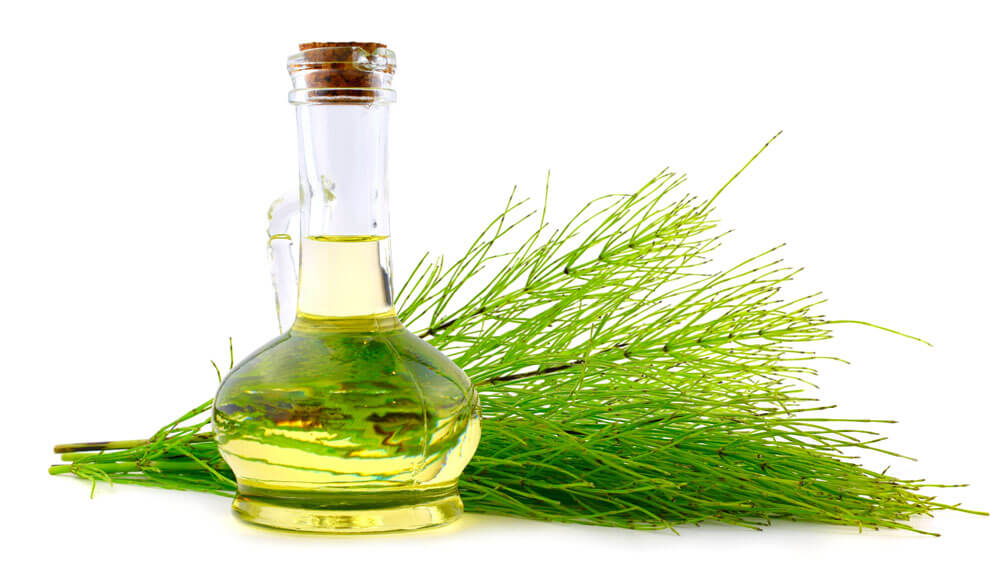
Field horsetail (Equisetum arvense) is an annual plant in the horsetail family. Horsetail does not produce flowers – reproduction is by spores. Native to Europe, it is a descendant of giant ancestors that grew in the Mesozoic era and formed extensive forests. Nowadays, horsetail grows commonly in meadows with clayey, sandy and moist soils. It can also be found wild along roadsides, riparian areas and in fields. In eastern Europe, horsetail is cultivated on a small scale.
Field horsetail stems are a rich source of minerals, especially silicon (5-10%). In addition, it also contains soles of potassium, calcium, phosphorus and small amounts of manganese. Horsetail also contains flavonoids, mimetic amounts of alkaloids, tannins, phytosterols, fatty acids (linoleic, oleic), silicic acids, benzoic acid, malic acid, citric acid, vitamin C, resins, lignans.
The genus horsetail is thought to have evolved in the Tertiary, arising from a much older genus of the related horsetail plant, dating from the Palaeozoic era – the Permian or Carboniferous. It has been suggested that it may be considered the oldest modern vascular plant. Horsetails have been used for centuries for, among other things, dyeing fabrics. Meanwhile, due to its high silica content, it was used to wash metalware and clean weapons.
Medicinal properties of field horsetail
Field horsetail has traditionally been used as a diuretic, haemostatic and remineralising agent. Initially it was thought that the diuretic properties of horsetail were due to the action of inorganic constituents (silicon), but today it is known that this action is due to the activity of flavonoids and saponins. Horsetail possesses significant haemostatic and scarifying properties, which is why it has traditionally been used to combat various types of haemorrhage. The remineralising effect of horsetail, due to the presence of significant amounts of silicon, should be highlighted.
Horsetail is a rich source of water-soluble silicon that is easily absorbed by the body (more easily than in other forms of plant origin). Silicon is involved in the human body in the synthesis of collagen and contributes to the consistency and hardness of bones, tendons, nails, hair, cartilage.
Horsetail in cosmetology and cosmetics
The skin owes its elasticity to the presence of collagen and elastin fibres, which are renewed with decreasing intensity as we age, resulting in sagging skin, the appearance of wrinkles, etc. Silicon has been found to help maintain an adequate amount of collagen and elastin, helping to maintain the structural integrity of the skin while promoting the development of new connective tissue components, ultimately delaying skin ageing. In addition, horsetail tannins have an astringent effect, which reduces fluid loss and protects against external damage, promoting tissue regeneration (healing) in cases of superficial wounds and burns. Horsetail is therefore particularly recommended for cosmetics with firming and regenerative effects.
Horsetail for blood vessels
Silicon helps to maintain the elasticity of blood vessels. This parameter, combined with the astringent effect, is crucial for proper blood circulation. Flavonoids are also ingredients that protect and strengthen blood vessels – they reduce vascular permeability and increase their strength. Flavonoids are very often used in the treatment of vascular disorders, e.g. varicose veins, chronic venous insufficiency, low vascular resistance, etc. Their protective effect is due to their high affinity for proline-rich proteins such as collagen and elastin. As these proteins are structural components of the veins, their degradation weakens the blood vessels, leading to swelling or puffiness of the lower body. Horsetail extract can therefore be used in cosmetics to improve overall blood circulation.
Remineralising effects
From a medical point of view, horsetail is very interesting for its remineralising action. This action is due to its high mineral content, especially silicon. The cosmetic use of silicon is mainly based on its mineral and vitamin content and often focuses on its ability to maintain the natural balance of the skin. These active ingredients naturally restore the skin’s vitality and improve its appearance. Horsetail extract is therefore recommended for products with a stimulating and revitalising effect.
Horsetail extract is also recommended for products with a stimulating and revitalising effect.
The astringent properties of the tannins present in horsetail are due to their ability to form complexes with various substances. When applied to the skin, the tannins coat the top layers of the skin and the mucous membrane, while protecting the deeper layers. Horsetail extract can therefore find use in cosmetics that regulate sebum secretion.