Try our novelties and bestsellers!»






Active ingredients in cosmetics
Vitamin C against ageing, photoageing and pigmentation
Aug
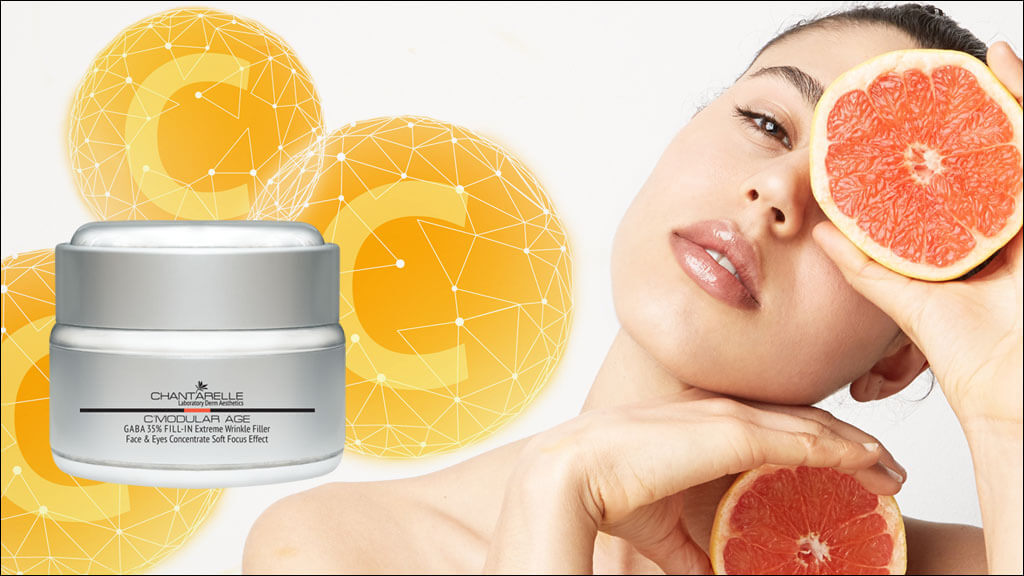
What are the properties of the vitamin C contained in the C’Modular Age cosmetic line? We know about its rejuvenating, anti-radical, brightening, depigmenting and capillary-strengthening effects. Let’s learn more about this most popular of vitamins.
Vitamin C – ascorbic acid is a polyhydric alcohol that is a derivative of glucose. The human body is not capable of producing it, so it must be taken in food or by other means.
skin ageing processes and “free radical scavengers”
Ageing processes occur in our tissues continuously, but the causes are varied – both resulting from natural processes and caused by external factors. Irrespective of the ageing mechanism, the presence of oxygen – an element essential to life, but also a danger – is crucial. Metabolic processes involving oxygen produce Reactive Oxygen Forms (ROSFs), and among these, free radicals are the most significant. Their role has been described by Denham Harman and is known as the ‘free radical theory of ageing’ and is considered one of the basic theories explaining ageing processes (Harman 2009). Our body has natural protective mechanisms that can be supported by antioxidants (Lee et al 2004), so-called ‘free radical scavengers’. The need to search for substances that support these processes is obvious (Shindo et al 1994). One of the most potent antioxidants is vitamin C. It is an essential substance for normal metabolism, but also has a number of desirable effects on the skin (Darr et al. 1992, Telang 2013).
What can vitamin C do?
Vitamin C is essential for collagen production and can directly stimulate collagen synthesis by activating pro-collagen mRNA transcription (Phillips et al 1994). Vitamin C improves the appearance of skin affected by photo-ageing and ageing and stimulates elastin synthesis. In addition, vitamin C reduces the production of metalloproteinases – extracellular matrix enzymes (metalloproteinases stimulate collagen degradation in the dermis). The stimulation of collagen synthesis by vitamin C gives it the ability to accelerate the healing of wounds, skin defects and soothe irritation. The action of vitamin C is therefore wide and varied – it inhibits the activity of metalloproteinases that destroy collagen structure, strengthens the connection between the epidermis and the dermis (Nusgens 2001). It is a potent inhibitor of tyrosinase activity and inhibits melanin synthesis (Choi et al 2010). It reduces the intensity of pigmented lesions, spots and hyperpigmentation and therefore has a brightening and whitening effect. Neutralises free radicals and increases antioxidant protection. It reduces damage and irritation caused by exposure to UV radiation and strengthens the skin’s protective capacity against its harmful effects.
Vitamin C can be delivered superficially, but as it is a hydrophilic substance it is important to ensure its transport (Telang 2013) and stability through the use of appropriate forms and derivatives (Stamford 2012).
Vitamin C in C’Modular Age cosmetics
Cosmetic formulations of C’Modular Age use stable derivatives of vitamin C for maximum effectiveness: SAP (Sodium Ascorbyl Phosphate) – a left-handed stable form of vitamin C with very high antimicrobial activity, and AA (Ascorbic Acid) – pure ascorbic acid with a stabilised formulation.
 Dr Marcin Wasylewski Chantarelle brand expert
Literature
– Choi YK, Rho YK, Yoo KH, Lim YY, Li K, Kim BJ, Seo SJ, Kim MN, Hong CK, Kim DS. Effects of vitamin C vs. multivitamin on melanogenesis: comparative study in vitro and in vivo. International journal of dermatology. 2010 Feb 1;49(2):218-26. – Darr D, Combs S, Dunston S, Manning T, Pinnell S. Topical vitamin C protects porcine skin from ultraviolet radiation-induced damage. British Journal of Dermatology. 1992 Sep 1;127(3):247-53. – Harman D. Origin and evolution of the free radical theory of aging: a brief personal history, 1954-2009.Biogerontology. 2009 Dec 1;10(6):773. – Kojo S. Vitamin C: basic metabolism and its function as an index of oxidative stress. Current medicinal chemistry. 2004 Apr 1;11(8):1041-64. – Lee J, Koo N, Min DB. Reactive oxygen species, aging, and antioxidative nutraceuticals. Comprehensive reviews in food science and food safety. 2004 Jan 1;3(1):21-33. – Phillips CL, Combs SB, Pinnell SR. Effects of ascorbic acid on proliferation and collagen synthesis in relation to the donor age of human dermal fibroblasts. Journal of Investigative Dermatology. 1994 Aug 1;103(2):228-32. – Stamford NP. Stability, transdermal penetration, and cutaneous effects of ascorbic acid and its derivatives. Journal of cosmetic dermatology. 2012 Dec 1;11(4):310-7. – Telang PS. Vitamin C in dermatology. Indian dermatology online journal. 2013 Apr;4(2):143. – Waibel JS, Mi QS, Ozog D, Qu L, Zhou L, Rudnick A, Al-Niaimi F, Woodward J, Campos V, Mordon S. Laser-assisted delivery of vitamin C, vitamin E, and ferulic acid formula serum decreases fractional laser postoperative recovery by increased beta fibroblast growth factor expression. Lasers in surgery and medicine. 2016 Mar 1;48(3):238-44.