Try our novelties and bestsellers!»







Skin care at home, Tips
Facial massage is an effective method for ageing skin
Jan
Massage (derived from the French word“masser” – to rub, from the Arabic. “mass” – to touch, feel to feel) – is a set of methods of mechanical action on tissues and organs. The basis of this method comes from the sciences physiology and anatomy.
What organs are most strongly affected by massage?
- skin
- neural receptors
- muscles
- microcirculation (blood vessels, lymphatic vessels)
Under the influence of the massage, the skin receptors are affected – either cold or warm, depending on the application method and the type of cosmetic preparations used. Massaging movements stimulate blood flow, which means nourishing the skin as a whole. The effect on lymph is to improve skin metabolism and reduce swelling. In addition, massage stimulates muscles and balances their tension. Some human muscles are hypertonic (excessively tense) and others are hypotonic (excessively relaxed). And this is particularly evident on the face.
Charm is beauty in motion. (Doris Lessing)
The concept of microcirculation, in its broadest sense, includes not only blood flow and lymph flow in the microvessels, but also the exchange processes occurring through the microvessel wall. It also includes interstitial (extravascular) transport of fluids, substances and cells. An important feature of the skin is that it ranks first among other organs and tissues in terms of the density of lymphatic microvessels. In fact, the human body is protected from pathogenic environmental influences by a powerful lymphatic membrane.
How can we influence the lymph during a massage?
The lymph does not have its own ‘pump’ as, for example, the heart has for the blood. But lymph also moves and we can influence two of its processes:
- rate of lymph filtration
- the speed of lymph movement
The rate of lymph filtration is influenced by:
- tissue pressure – due to the elasticity of the surrounding
- osmotic pressure – dependent on the concentration of solutions in the interstitial fluid.
lymphatic pressure – dependent on the concentration of solutions in the interstitial fluid. The easiest way to influence tissue pressure is from the outside. This is what we can do with massage. The rate of lymphatic movement is influenced by:
- contraction of skeletal muscles
- negative pressure in the thoracic cavity and increase in thoracic volume during inhalation
- presence of smooth muscle in the walls of large lymphatic vessels
If we massage along the relevant lymphatic lines, we affect the speed of lymphatic movement. In this way, we can reduce swelling of the face and eyes, including age-related swelling.
Jade stone
The jade stone is often confused with jade as they have similar properties. Both stones are formed under the influence of high-pressure aluminium silicates. Jadeite is harder, denser and has a higher refractive index than nephrite, but, like the latter, has remarkable cohesion and compactness. One of the hardest minerals on earth, diamond, has a hardness of 10 on the Mohs scale, jadeite has a hardness of 7 and nephrite a hardness of 6.5. This makes jadeite extremely resistant to all mechanical pressures. Jadeite comes in a variety of colours, the green variety being the best known. It can also be pink, colourless, yellow, purple or white.
Heat and cold massage techniques
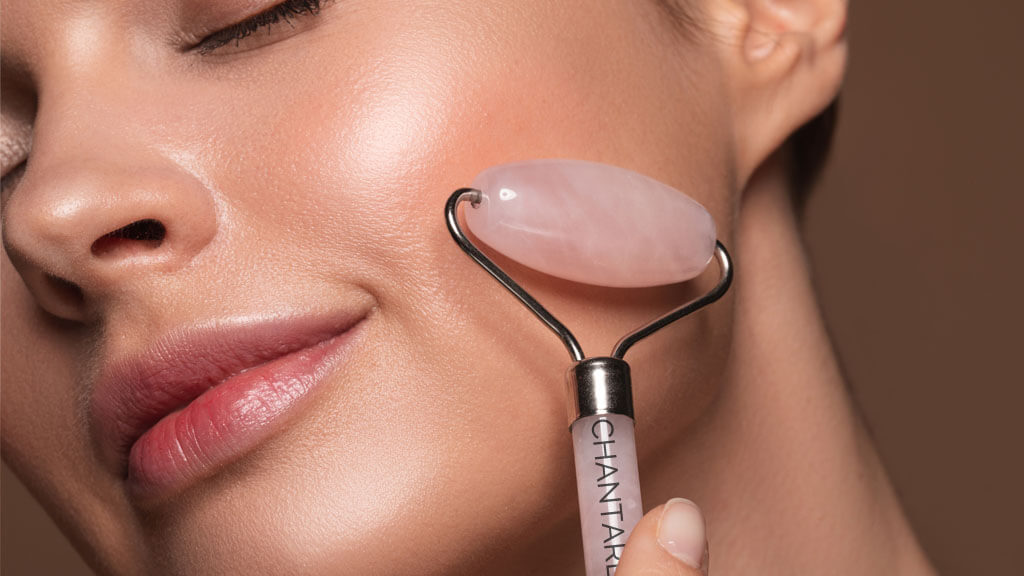
Any harmless method of stimulating lymph flow will not only restore the skin’s turgor, which is particularly important in cosmetology, but also support its functions, which weaken with age and with dermatological problems. The jade massager, also known as a jade roller, is an adaptive stone. This means that it heats up during use. We can then benefit from its ‘heat power’. When the warm stone is touched, the blood vessels dilate, which leads to congestion and an increase in skin temperature. This is accompanied by an acceleration of metabolic processes, enhancement of skin regeneration and resorption of tissue breakdown products. The roller massage is ideal for mature skin prone to inflammation, as an ‘enhancer’ – increasing the penetration of active ingredients from cosmetic concentrates. Other uses are obtained when the massager is cooled in the refrigerator. The ‘cold’ treatment is suitable for vascular skin, massaging the skin around the eyes, firming the skin and improving skin tone. However, you should not count on the serum penetrating deeply at that time, as the vessels constrict under the influence of the cold. Therefore, this method is suitable for use with cosmetics of gel consistency, but also with masks or night creams. The roller massage can also be used on almost dry skin. However, the gliding effect should be maintained. We can alternate hot and cold massages to strengthen our skin. We then train the blood vessels to dilate and then constrict. At the same time, it is worth pointing out that during a massage we also intensively affect the nerve receptors, which gives a feeling of relaxation.
How to perform a jade roller massage?
- prepare your skin: cleanse it and apply a cream or serum for gliding
- with clean hands, disinfect the massager and then start the treatment, using light movements along the line – as shown in the graphic below.
- Put the massager on the skin.
- ride along each designated line up to four times, trying to lightly press the skin.
- If you want to smooth out wrinkles, pay more attention to the area of the skin where they are most prevalent.

Benefits of jade roller massage
- reduction of facial swelling and bags under the eyes
- lymphatic drainage
- leveling of facial contours
- removal of fine lines
- loss of fine wrinkles
- relaxation of facial muscles
Chantarelle creams, concentrates and masks from the home care range are recommended for the jade roller massage.
 dr Khrystyna Shekhovtsova
Chantarelle expert, dermatologist and aesthetic physician