Try our novelties and bestsellers!»






Cosmetic treatments, Aesthetic cosmetology, Dermatology
The power of light. The world of laser and LED technology.
Jun
Light therapy has quite a long history. It wasusedas early as by the Greek physician Hippocrates. He treated skin diseases with sunlight. He sootted patients with eczema or acnein the shade of trees in an olive grove. Then ultraviolet radiation was filtered through the branches of the treesand infrared radiation reached the skin, which had a beneficial effect on the dermatosis in question. The sessions did not last longer than ten minutes.
Families of laser sources
Today, the technique has developed considerably and light is widely used in physiotherapy and hardware cosmetology. Depending on what its source is, there are two main technologies:
-
- Lamps: xenon lamps (in IPL devices), LEDs (chromotherapy devices)
- Lasers: lasers (solid state, gas, dye/liquid, diode)
Unlike electricity and sound, which do not have a specific target in the medium in which they propagate, light does. It is the atoms and molecules of a substance that can absorb electromagnetic radiation at specific wavelengths. The main parameters of laser radiation:
- wavelength of the radiation generated
- power
- duration and mode (pulsed or continuous) of irradiation
- radiation source (here laser type)
Laser power:
- Low power lasers (1 to 5 mW)
- Medium power lasers (6 to 500 mW)
- High power lasers (6 to 500 mW)
- High-power lasers (above 500 mW)
- Lasers with high power (above 500 mW)
Low- and medium-power lasers are included in the group of so-called biostimulative (low intensity) lasers. High-power lasers, on the other hand, are classified as photodestructive and are mostly used in surgical procedures.
Laser types:
- Solid-state lasers – use a crystalline matrix doped with metal ions that absorb and re-emit photons
- Pigment (liquid) lasers – use the fluorescence of certain dyes in solution or are based on solutions of non-fluorescent dyes excited by a solid-state laser or flashlamp.
- Pigment (liquid) lasers – use the fluorescence of certain dyes in solution or are based on solutions of non-fluorescent dyes excited by a solid-state laser or flashlamp.
- Gas lasers – in this type of laser, the crystal is replaced by a gas (argon, krypton).
- Diode lasers (semiconductor lasers) – consist of semiconductor crystals.
LDiode lasers (diode lasers) based on semiconductors give significantly higher radiant power and thus a higher coefficient of performance (COP) than other types of lasers.
Capacity laser (COP) is the ratio of the power generated by the laser to the power that the laser device consumes to produce it. That is, in simple terms, the ratio of the light energy released to the energy consumed to obtain it.
For gas lasers, the COP is – 1-20%, for solid-state lasers – 1-6%, and for diode lasers – 10-50% (up to 95% in some designs). Diode lasers therefore have very low power consumption (current – a few tens of mA, voltage – up to 10V), while ‘classical’ lasers may require a voltage of thousands of volts. As a result, diode lasers are very compact and do not require special operating conditions.
LED light
In addition to lasers, there are also so-called light-emitting diodes (LED), which gave LED therapy its name. Light-emitting diodes are not exactly the same as laser diodes. For example, the radiation generated by light-emitting diodes is not scattered. This means that laser light gives focused radiation, while LED light gives diffuse radiation.
How does LED therapy work?
LEDs convert current into light with a specific spectrum (optical spectrum). Light is both a wave and energy. A wave of a certain length acts on different skin structures, which absorb this emitted light energy. Each colour of the optical spectrum has a different wavelength and, depending on the wavelength, the light can penetrate into the skin to a different depth from 0.3mm to 3mm, producing different effects.
The visible colour spectrum of the optical spectrum:
- violet 380-450 nm
- blue 450-485 nm
- green 500-565 nm
- yellow 565-590 nm
- orange 590-625 nm
- red 625-780 nm
- IR above 810 nm (can be subdivided into ranges: near IR 780 to 2500 nm, medium IR 2500 to 25000 nm, far IR 25000 nm up to 1 mm)
LED light spectrum
Violet light (Violet) 450-485 nm – penetrates shallowly, to a depth of 2 mm. It is captured by porphyrins produced by the bacteria Propionibacterium acnes. It has an antibacterial effect and is therefore recommended for acne. It evens out skin tone, lightening hyperpigmentation and age spots. It is also used in anti-aging dermotherapy. Violet light also stimulates the receptors responsible for the secretion of serotonin, i.e. it has an antidepressant effect. Green light (Green) 500-565 nm has the ability to calm and regenerate the skin. Green light is best absorbed by haemoglobin and melanin, hence treatments dedicated to this wavelength of light are effective in the reduction and levelling of vascular lesions and erythema symptoms, in sensitive and irritated skin such as AD. It has calming properties that can help reduce inflammation. It also helps to address hyperpigmentation for an even and brighter skin tone. Green LED light therapy is also used to treat under-eye bruises, scars and stretch marks. Red light (Red) 590-780 nm – penetrates 10-20 mm deep into the skin. This wavelength has been shown to penetrate deep into the skin and tissues, promoting blood flow and relieving pain. Stimulates fibroblasts, leading to increased synthesis of collagen, elastin, glycoproteins and glucosamines. Has an anti-inflammatory effect. In alopecia it can stimulate hair growth. It is also used in rehabilitation after invasive surgery, accelerates recovery and shortens the rehabilitation period. Infrared light (IR) above 810 nm – can penetrate up to 50 mm deep into the skin. In the cell, it is captured by flavoproteins. IR radiation can have a beneficial effect on skin texture and reduce the wrinkle formation process. This happens by increasing the amount of collagen and elastin in the dermis through stimulation of fibroblasts. In addition, IR light increases cell metabolism, which helps to remove toxins from the cells.

Laser and LED light comparison
The wavelength also determines the depth of penetration of the light into the skin – the longer the wavelength, the deeper the penetration of the light radiation. For example, with LED therapy, IR rays penetrate tissue to a depth of 7 cm, while visible light penetrates to 1 cm and UV rays to a depth of 0.5-1.0 mm (figure). Whereby the wavelength is inversely proportional to the energy of the light quanta. This means that short-wave radiation has more energy than a beam of long-wave light.
|
PDT MASTER® – magneto-LED-laser
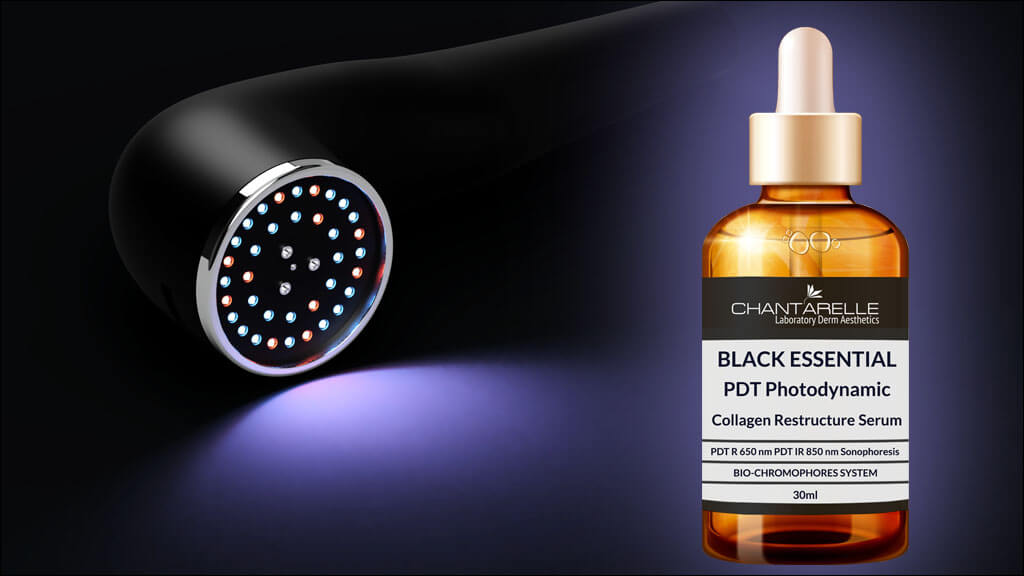
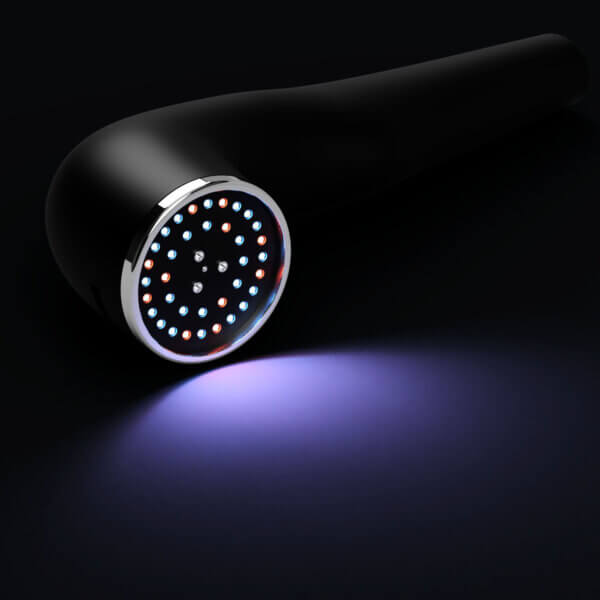
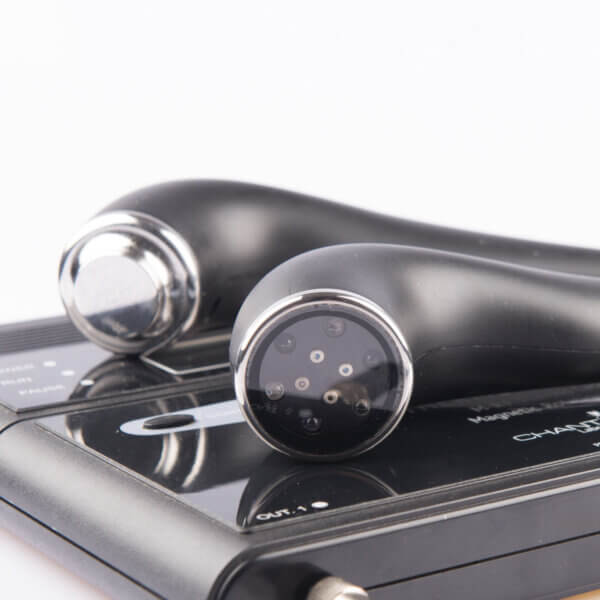
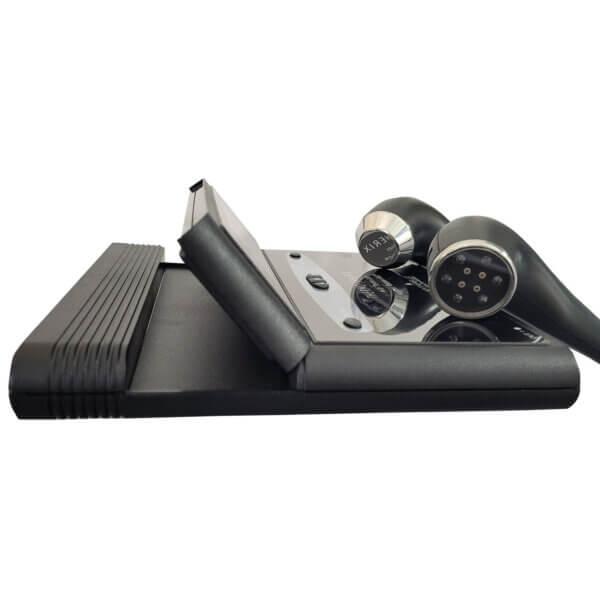
The PDT MASTER® brand Chantarelle devices are the only ones on the market for professional dermo aesthetics that combine four technologies:
- low-energy laser with 3 diodes emitting a beam of 635 nm (Red – red light).
- 36 LEDs in 4 colours: violet 395 nm, blue 470 nm, green 525 nm, red 650 nm
- pulsating magnetic field with a maximum power of 10mT – increases the therapeutic effect, has a biostimulating effect, accelerates regenerative processes and assimilation of active ingredients contained in the preparations. It improves blood and lymph circulation, increases oxygenation and nutrition.
- PDT photodynamic treatments – based on light-sensitive PDT preparations with proprietary bio-chromophores and advanced active ingredients.
Choose the best device for increasing the effectiveness of your work.
 dr Khrystyna Shekhovtsova
Chantarelle expert, dermatologist and aesthetic physician
Chantarelle cosmetic devices
Lasers & accessories
PHOTO-DYNAMIQ® – LASER kosmetyczny – skuteczne zabiegi PDT – 3 sondy
Lasers & accessories
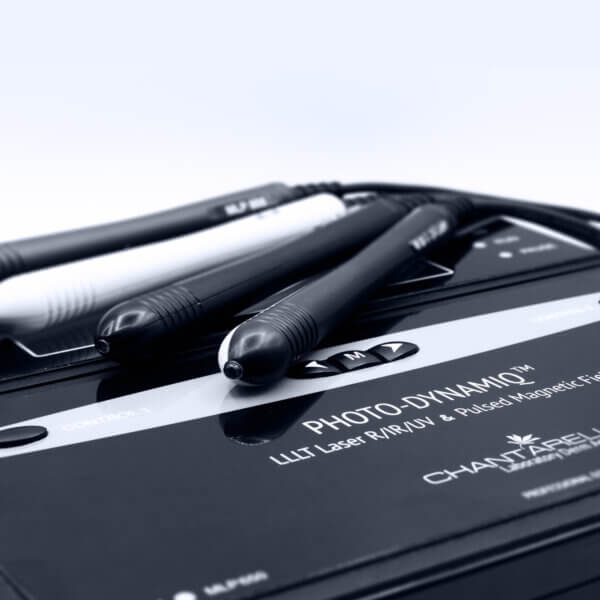
PHOTO-DYNAMIQ® – cosmetic LASER – effective PDT treatment – 4 probes
Lasers & accessories
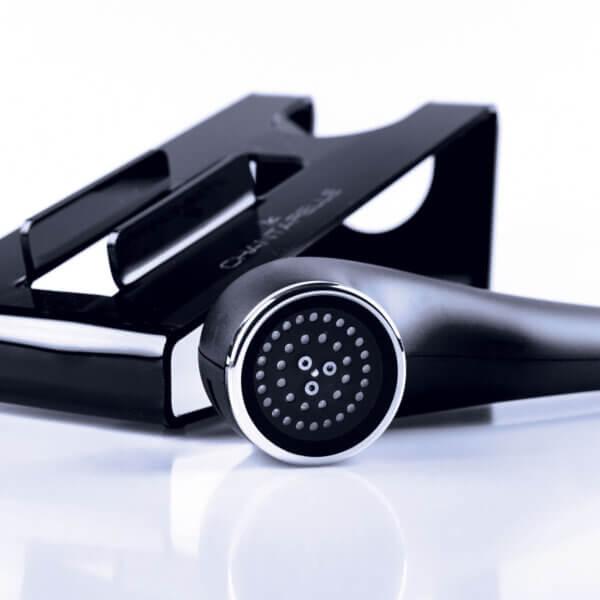
PDT MASTER® magneto-LED-laser for PDT photodynamic treatments
Lasers & accessories
THERMO-SPHERIX® – cosmetic LASER – body slimming, rejuvenation and facelift