Try our novelties and bestsellers!»







Cosmetic treatments, Active ingredients in cosmetics, Aesthetic cosmetology
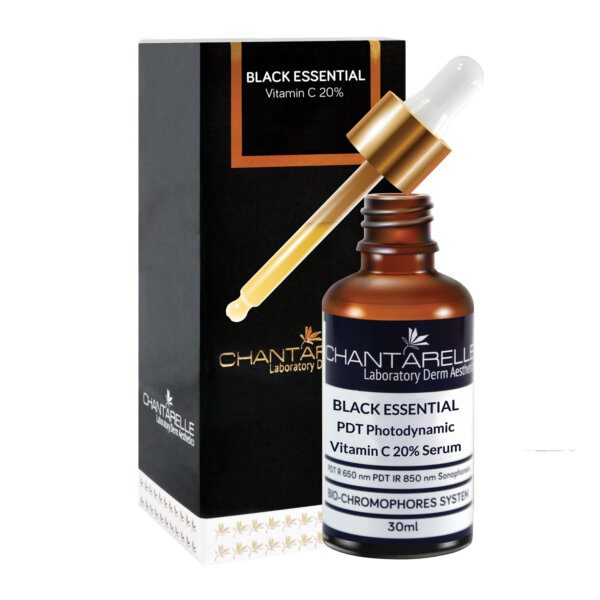
Vitamin C concentrate – PDT Black Essential serum
Apr
Serum with vitamin C is the best remedy for skin problems such as hyperpigmentation, visible effects of ageing. In the winter and spring, after a diet devoid of fresh fruit and vegetables, we tend to lack vitamins. What are vitamins and how can they help us? They are substances that are essential for our body to function properly, but are not produced by it. They must therefore be supplied – most often with food. Vitamin C particularly stands out in this group.
Vitamin C is otherwise known as L-ascorbic acid. It is a substance from the group of polyhydroxy alcohols, with antioxidant activity. It influences the synthesis of hormones and neurotransmitters, as well as collagen. It also influences wound healing and strengthens the body’s resistance to infection. Its steroisomers such as D-ascorbic acid are not vitamins, although they may have some of the characteristics of the former. For example, they may exhibit antioxidant activity.
It is important to remember that it is a sensitive substance and can degrade when exposed to temperature, for example. Another important issue is its bioavailability and rate of absorption. This issue is particularly relevant for cosmetic preparations containing vitamin C applied superficially to the skin. The skin, as we know, is a barrier to the inside of our body and absorption through it is hindered. As vitamin C is hydrophilic in nature, it is important to administer it in such a form that it is not deactivated. The second reason is to make transport through the skin as efficient as possible. One such way is to lower the pH below 3.5, but this is not desirable due to the natural pH of the skin.
Vitamin C in cosmetology
Stable forms, however, are vitamin C derivatives – ascorbic acid esters such as ascorbyl palmitate and ascorbyl phosphate (sodium salt), ascorbyl palmitate or ascorbyl isostearate. An additional advantage of the derivatives is that they can modulate the hydrophilic character typical of vitamin C, thereby facilitating transport through the skin and increasing the bioavailability of such substances in epidermal administration. It is also possible to increase both the stability, safety of use and bioavailability of vitamin C through the use of suitable carriers. Examples of such are liposomes. Liposomes are lipid structures made of a spherical phospholipid bilayer containing an aqueous phase within its structure capable of carrying hydrophilic substances. Liposomes are therefore a carrier for substances, allowing them to be protected from various factors and increasing the efficiency of transport of such substances. The structure of liposomes depends on their composition as well as the manufacturing technique.
Serum with vitamin C – modern liposomes in PDT Black Essential serum
For cosmetic laboratories, it is therefore important to use raw materials that are proven to work and have the best performance and safety in action. An example of a liposome carrier is Vecticell. Hiding the active substances in such a carrier increases both their durability and their permeability, and these properties are proven in scientific studies. Vecticell contain pharmaceutical-standard phosphatidylcholine, so they integrate perfectly into cell membranes. They are also characterised by biodegradability and biocompatibility. The PDT Black Essential Vitamin C treatment is recommended by Chantarelle experts for all skin types – rough, dry, grey, dull skin with signs of photo-ageing and ageing, with wrinkles, vascular skin, skin with hyperpigmentation and acne scars. It is also recommended as a banquet treatment.
 dr Marcin Wasylewski
expert of Chantarelle Laboratory Derm Aesthetics