Try our novelties and bestsellers!»







Cosmetic treatments, Active ingredients in cosmetics, Dermatology
Which acids for sensitive skin?
Mar
Treatments for sensitive skin are often problematic for cosmetologists and dermatologists. Reactive skin reacts much more strongly to many cosmetic products. Chemical peels have to be selected especially carefully for it. Which acids for sensitive skin will give the best results and not irritate it?
Sensitive skin vs rosacea
Sensitive skin and rosacea are dermatoses sometimes diagnosed at the same time. They have a lot in common, however, they are two different problems. Almost always, the main reason in the development of hypersensitive skin is the violation of the integrity and increased permeability of the stratum corneum, which usually provides a stable barrier to protect the skin from external aggression. With sensitive skin, there is an increase in the pH of the skin to 6.5, which disrupts the balance of the microbiome. Acne rosacea is a chronic, recurrent facial skin disease caused by vasomotor oedema disorders, which is polyetiological in nature and characterised by a staged course.
Main steps in sensitive skin care
-
- Limit factors that increase skin sensitivity: spicy food, coffee, thermal factors and stress triggers, etc.
- Protection of the skin against harmful external factors, including SPF protection and protection against cold.
- Protection of the skin against harmful external factors.
- Gentle cleansing with non-aggressive surface-active ingredients.
- Rebuilding and strengthening barrier function: skin acidification and ceramide supplementation
- Systematic and adequate hydration.
- Reducing the excitability of the receptor apparatus.
- Systematic and adequate hydration.
- Inhibition of inflammatory processes through the use of appropriately selected ingredients.
This comprehensive and holistic approach will help alleviate skin hypersensitivity problems.
Acids for sensitive and vascular skin
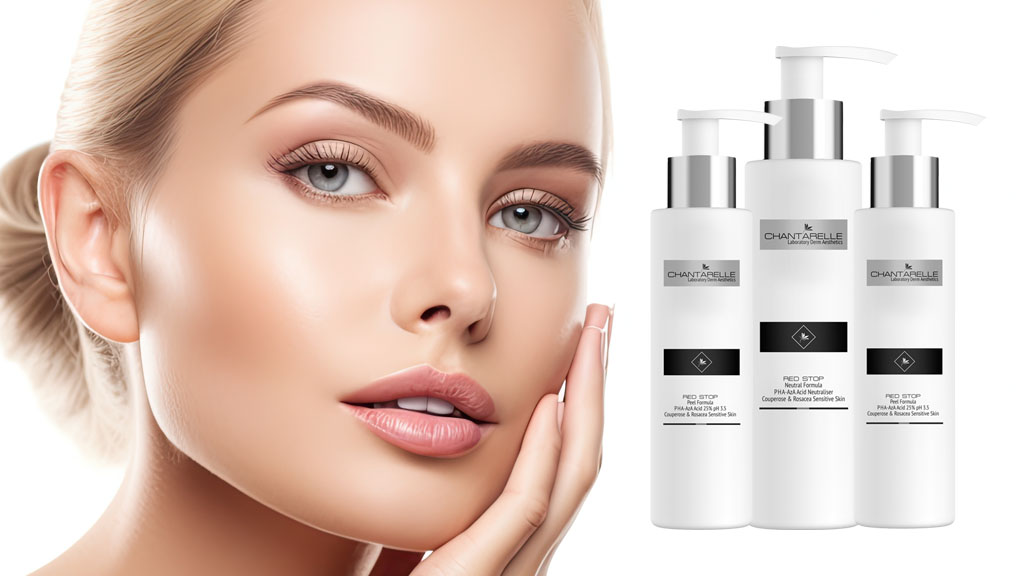
Azelaic acid, lactobionic acid and gluconolactone have a mildly exfoliating action, without irritating properties. The mild pH reaction does not irritate sensitive skin. With regular use of such peels, a reduction in erythema and inflammatory lesions is observed. These acids actively reduce dilated capillaries and telangiectasias. In addition, they act as a “scavenger” of free radicals that activate inflammatory processes. They are highly moisturising substances, helping to maintain the skin’s normal, natural hydration balance. Azelaic acid, lactobionic acid and gluconolactone can be found in the M-acids and Red Stop Couperose & Sensitive Rosacea brands Chantarelle.
Acid cocktail for reactive skin
Also of particular note is the Sensiter 45.5% pH 3.2 peel from the Platinum Peel&Cure line for thin, delicate, vascular and sensitive skin. Shikimic acid promotes remodelling of the dermis by creating a ‘niche’ of stem cells, which promotes angiogenesis. This is particularly important for sensitive skin. Additionally, lactic acid and gluconolactone help to deeply moisturise and regulate the skin’s water balance. The Sensiter treatment is performed with the PDT Master® biostinylation laser. The action of this LLLT laser stimulates skin healing, reduces inflammation and promotes skin rejuvenation.
Acid effects on sensitive skin
- Removing old, keratinised epidermis promotes a faster renewal of cellular composition and a strengthening of the skin’s barrier function.
- This contributes to a reduction in dryness of the skin – TEWL decreases and NMF content increases.
- Further stimulation of the skin’s barrier function.
- Stimulate the reconstruction of the intercellular lipid layers of the stratum corneum.
High demands are placed on the active formulas of sensitive skin care products. They must respond to the complex needs of sensitive skin. The active ingredients correct the mechanisms of sensitivity, improving the quality and condition of the skin, but at the same time preventing its premature ageing > read about the phenomenon Inflamm-ageing.
 dr Khrystyna Shekhovtsova
Chantarelle expert, dermatologist and aesthetic physician