Try our novelties and bestsellers!»






Active ingredients in cosmetics, Cosmetic treatments, Skin care at home, Tips
Retinol season – the ideal rejuvenating and regenerating ingredient
Nov
Autumn and winter are the ideal time for retinol treatments and cosmetics. If your goal is beautiful and radiant skin, reduction of wrinkles and other structural imperfections – retinol is the ideal choice. The effect of retinol on the skin has been compared to an iceberg. We can only see the tip of it, such as smoothing the skin, while the most important effects of retinol are the renewal of the skin in its deeper layers.
Retinoids are a group of substances that act on cells like vitamin A. Structurally, they may resemble or differ from vitamin A (synthetic retinoids), but they all have an affinity for nuclear retinoid receptors and execute their biological activity through them. Retinoids are small lipophilic molecules that readily penetrate the stratum corneum. In the epidermis, retinoids control keratinisation and pigmentation processes, and in the dermis layer, they contribute to the reconstruction of the intercellular matrix, which is gradually degraded by ageing or UV radiation. The transfollicular route allows an increased concentration of retinoids directly in the skin follicles, which is important for acne-prone skin. There are many scientific publications on the effects of retinoids on the skin. In the table below, we outline the most important effects of retinol.
Effects of retinol on the skin
| Place of action | Odpowiedź komórkowa | Effect of action |
| Keratinocytes | Stimulation of division, maturation and migration | Smoothing microrelief Reduction of wrinkles Reduction in the clarity of wrinkles, evening out the colour |
| Sebocytes | Reduction of sebum secretion | Reduction of skin shine |
| Fibroblasts | Stimulation of proliferation | Improvement of skin elasticity and turgor Smoothing of fine wrinkles |
| Langerhans cells | Modulation of macrophage antigen-presenting capacity Reduced turnover of inflammatory mediators in keratinocytes | Reduction of erythema Reduction of local oedema |
Forms of retinol
- Retinol palmitate and retinol acetate for the face are frequently used ingredients in anti-ageing cosmetics for mature skin and skin with wrinkles. These very substances are therefore found in popular drugstore creams and concentrates.
- Retinol – a pure form of vitamin A – is recognised in the world of cosmetology as one of the main “vitamins of youth”, and as one of the best studied substances in the cosmetic industry.
- Retinaldehyde (retinal) is readily converted to retinoic acid, and interacts with RAR receptors located in the nuclei of fibroblasts and basal keratinocytes.
- Retinoic acid is the most powerful representative of the entire retinoid group. However, it also has the strongest irritant effect. And it is also extremely unstable when exposed to light. It is sometimes used in cosmetics in the form of the so-called “yellow” peel.
According to their biological activity, retinoids can be built into the following chain: Retinyl palmitate ⇒ Retinol (retinol) ⇒ Retinaldehyde (retinal) ⇒ Retinoic acid (retinoic acid)
Bio-retinol from blue algae
There is also a peptide form of retinol – bio-retinol blue. It is extracted from specific unique blue endemic microalgae (of the Cyanophyta group) growing in the waters of Klamath Lake located at an altitude of 1,300 m in southern Oregon. Extracts from these micro-organisms, known as ‘blue retinol’, exhibit retinoid-like effects without side effects. Their effects include a reduction in wrinkles and smoother skin. Blue retinol, like traditional retinol, influences the differentiation of keratinocytes to smooth and increase the density of the epidermis, but does not cause any negative effects due to the accumulation of retinol in the tissues.
Rules for the use of cosmetics with retinol
- Most forms of vitamin A are not stable in sunlight, so retinoids work best during nighttime skin care.
- Retinol is quite unstable, so cosmetics in capsuled form should be chosen.
- Retinol is not a good choice.
- Gradually introduce preparations with retinol into your daily skincare.
- To avoid negative consequences in the form of irritation and redness, apply cosmetics only to dry skin.
- At the beginning of your skincare regimen, retinol causes dryness and flaking, so combine it with moisturising products.
- When treating with retinol in the morning, always apply a cream with high SPF protection.
- Retinol products can be used either on the whole face or on selected parts of the face or body.
Optimal duration of retinol application
Research (“Two concentrations of topical tretinoin cause similar improvement of photoaging but different degrees of irritation” Griffiths CE, Kang S, Ellis CN et al.) shows that in order to achieve a significant correction in older patients, a course of treatment should last at least 48 weeks. If we are talking about a correction of the average value – the duration of dermocoration should not be less than 36 weeks. On the other hand, for most people, the therapy should not last less than 24 weeks.
Cosmetics from Chantarelle with pure retinol
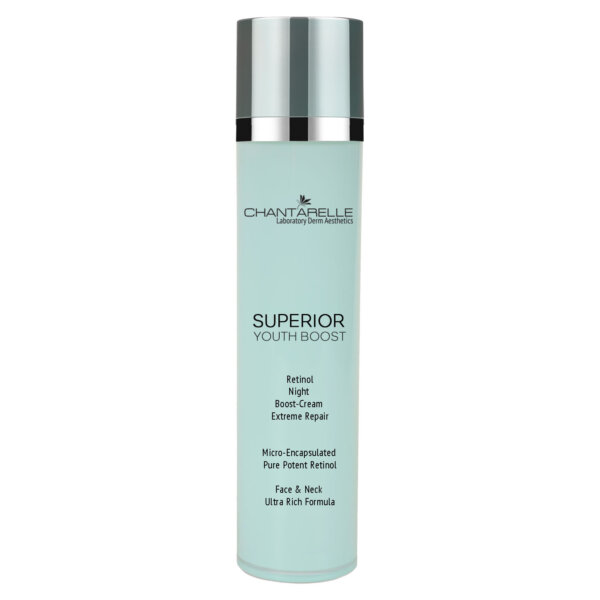
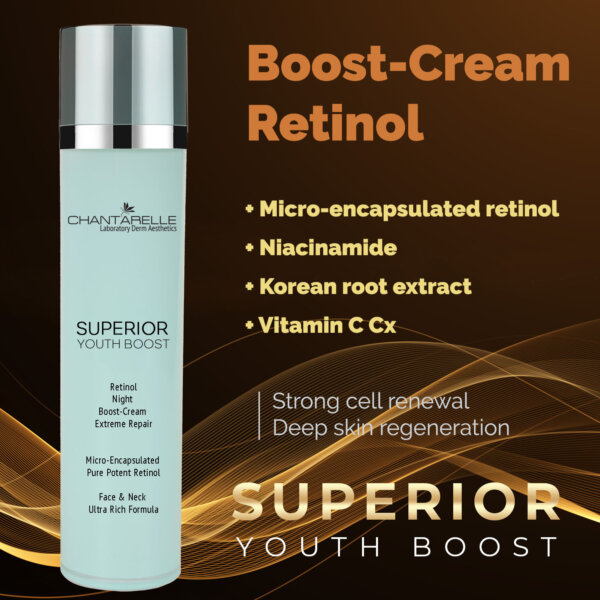
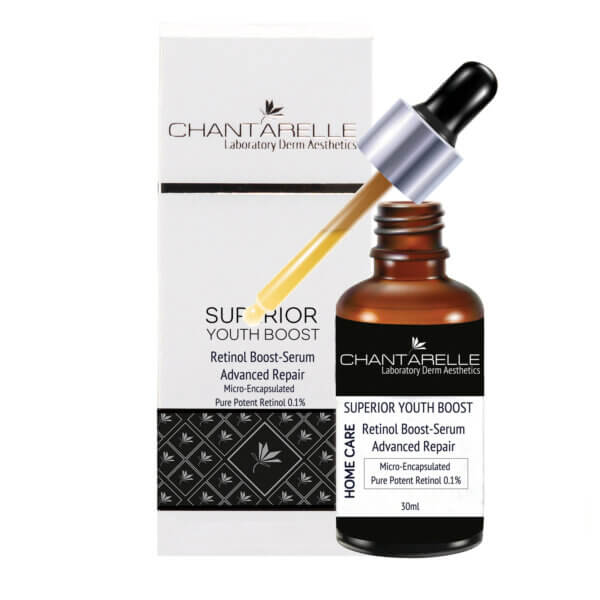
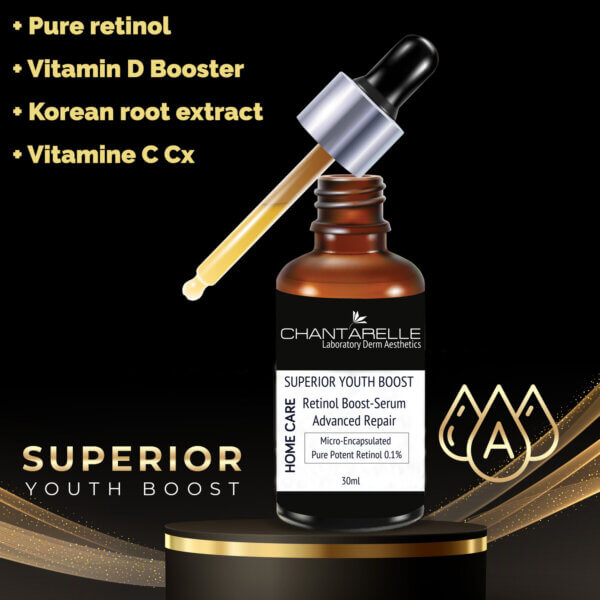
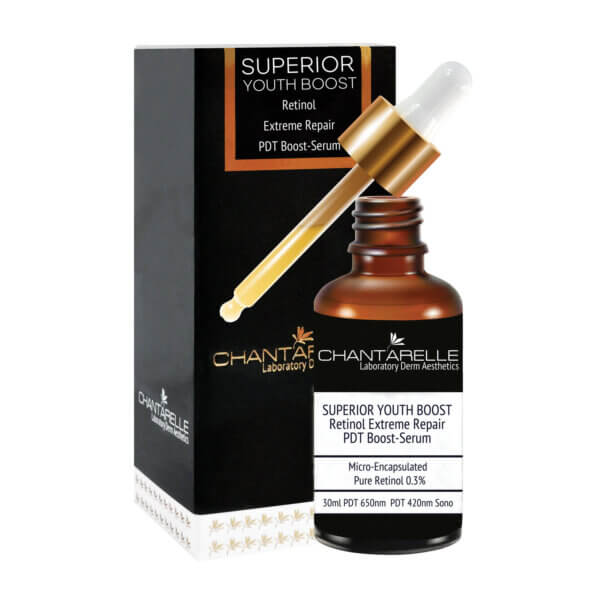
Chantarelle formulations contain microencapsulated pure retinol, encapsulated in unique ultra-small molecule microcapsules, which is released when directly applied to the skin by smearing. This ensures that it retains its properties. Within the microcapsule, it is protected from light, temperature, pH and oxidation. The stimulating effects of the Superior treatment with retinol are multiplied by the PDT laser application. The Chantarelle treatment range includes two treatments with pure microparticle retinol (vitamin A 233310 IU/g):
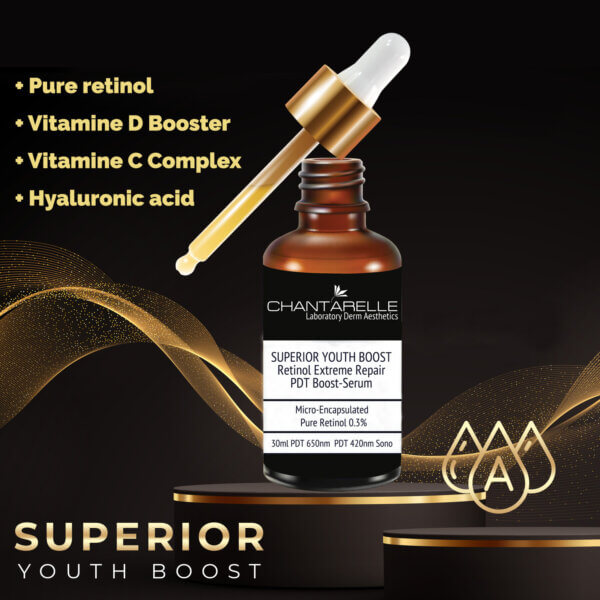
- Superior Youth Boost with pure microencapsulated retinol plus niacinamide and GABA acid. This is a year-round intensive treatment for cell renewal and regeneration of mature, oily, acne-prone skin and skin with imperfections such as hyperpigmentation, scars. Recommended application of the treatment – with low power laser LLLT.
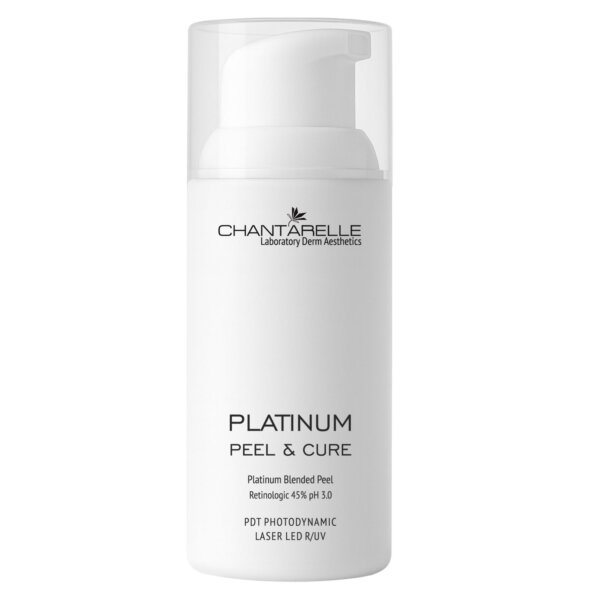
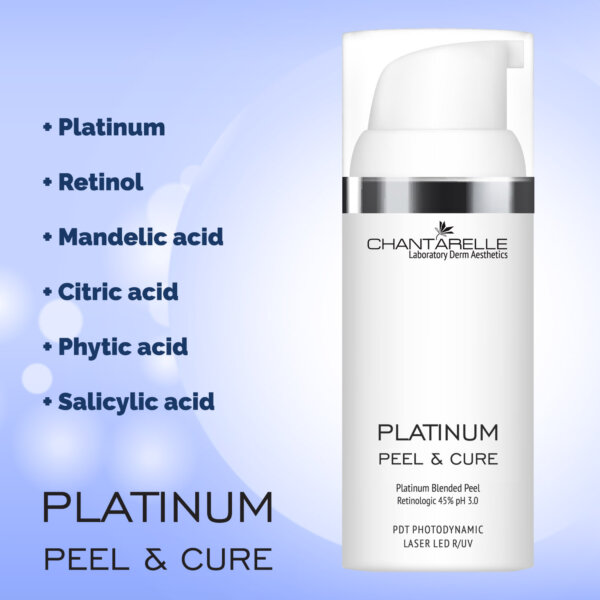
- Platinum Peel&Cure Retinologic 45% pH 3.0 – laser peeling with retinol, a mix of selected acids and platinum intended especially for mixed, oily, seborrhoeic acne-prone skin. Recommended application of the treatment – with low-power laser LLLT.
- Nutri Maxx with bio-retinol blue – a plant equivalent of retinol from endemic algae. The treatment is designed to regenerate and repair and support the natural renewal mechanisms of mature, grey, tired skin that lacks energy and vitality.
 dr Khrystyna Shekhovtsova
Chantarelle expert, dermatologist and aesthetic physician
Retinol in Chantarelle cosmetics