Try our novelties and bestsellers!»






Active ingredients in cosmetics
HYA-STIM 3-PEPTIDE – Hyaluronic acid stimulator
Jun
Summer is a time for holidays and relaxation. Whether we choose a more or less active holiday, we usually regain our vital energy and regenerate our strength during the holidays. Does our skin get the same rest when we spend time at the beach or on mountain hikes? If we want our skin to be as rested as we are after a holiday, we need to help it rejuvenate and regenerate.
How does skin age?
We need to counter both the effects of the sun, dryness and the inexorable passage of time. These factors all combine and accelerate skin ageing. Although we divide these processes into intrinsic and those caused by extrinsic factors such as sunlight, their effect is the same. The main symptoms of ageing are increasing skin degradation processes that result in the formation of fine lines and wrinkles, mainly around the eyes and mouth. The lack of firmness, elasticity and healthy colour becomes apparent, as well as poorer hydration and rapid drying of the skin.
The primary causes of ageing are changes in structural proteins such as collagen or elastin, but also changes in glycosaminoglycans (GAGs), the most important representative of which is hyaluronic acid (Baumann 2007). These compounds are polysaccharides that have the ability to bind large amounts of water, increasing their mass up to 1,000 times. Ageing of the skin results in a decrease in hyaluronic acid, resulting in the formation of wrinkles and a decrease in elasticity and firmness.
Hyaluronic acid for skin rejuvenation
Are we helpless against these changes? Not at all – we can improve skin parameters in various ways. We can deliver hyaluronic acid by injection, but these treatments are invasive and the product is delivered spot-on. However, we can also deliver hyaluronic acid in cosmetic products. Is this effective? After all, the main function of the skin is barrier function. This is true, but it is precisely for this reason that care must be taken to ensure the correct composition of the preparation used. Because hyaluronic acid is a polymer with different particle sizes, the extent of its transport through the skin can be determined (Brown et al. 1999).
Peptides for skin rejuvenation
Is this all we can do to help our skin regain its youthful appearance? No – we can use substances that trigger regenerative processes in the skin – for example, the processes of producing glycosaminoglycans in the skin. Such substances can be peptides, which are natural polymers made up of amino acid residues. Polypeptides are proteins, i.e. substances of fundamental importance for biological life. Proteins are large molecules, often impermanent and virtually impenetrable through the skin. Therefore, peptides that perform the functions of selected proteins and provide durability and permeability are increasingly used in advanced cosmetics. Peptides used in cosmetics can be divided into three groups: signal peptides, peptides affecting neurotransmitters and carrier peptides (Lupo and Cole 2007).
HYA-STIM tripeptide
The first group may include the tripeptide HYA-STIM, which stimulates the synthesis of glycosaminoglycans in the skin. Clinical studies have proven both safety and efficacy in the rejuvenating effects of cosmetic products containing this active ingredient. Remodelling and facial oval improvement effects are indicated (Garre et al. 2017). Further studies indicate significant protection against sun-induced skin damage associated with oxidative stress. The skin of patients using tri-peptide-containing formulations maintained an optimal composition of the skin matrix and its structural proteins, proteoglycans and water content, improving skin appearance, skin tone, and leading to wrinkle reduction and improved hydration (Garre et al. 2018). Also, research by Polish scientists indicates a beneficial effect of this tripeptide on the structural proteins of fibroblasts and keratinocytes. Thanks to advanced scientific knowledge, we can improve the condition of mature skin by influencing processes related to the restoration of the skin’s structural components, whose deficits occur due to ageing processes.
Nutri Maxx – cellular anti-ageing cosmetics
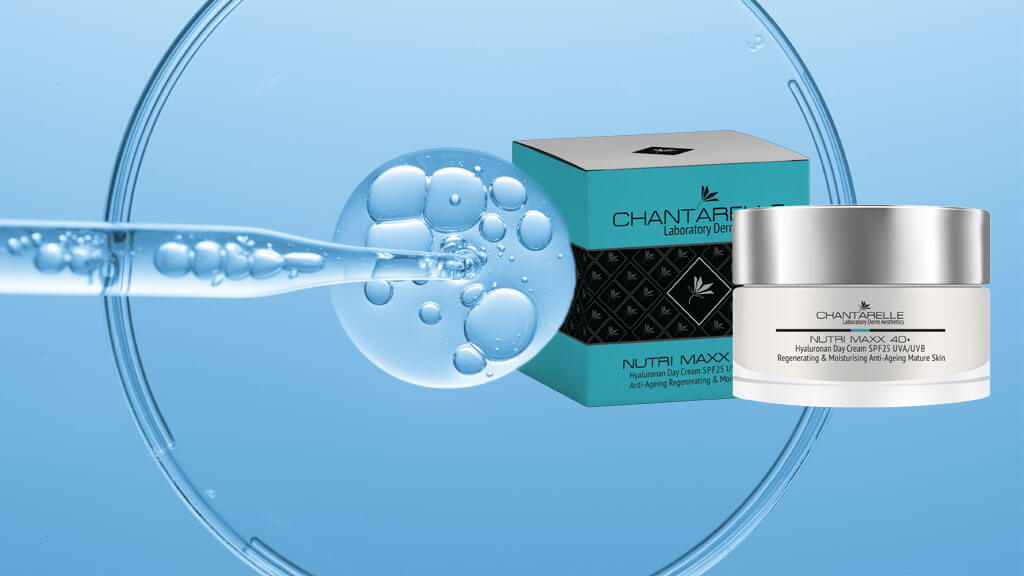
These ingredients, including hyaluronic acid of appropriately selected molecular weight and the tripeptide HYA-STIM – which stimulates hyaluronic acid synthesis and delays cellular ageing – are found in cosmetics of the Nutri Maxx line. The latest scientific advances used in the laboratories of Chantarelle allow our skin to rejuvenate and relax.
 Dr Marcin Wasylewski
CHANTARELLE Laboratory Derm Aesthetics expert
Literature:
– Baumann L. Skin ageing and its treatment. The Journal of Pathology: A Journal of the Pathological Society of Great Britain and Ireland. 2007 Jan;211(2):241-51. – Brown TJ, Alcorn D, Fraser JR. Absorption of hyaluronan applied to the surface of intact skin. Journal of investigative dermatology. 1999 Nov 1;113(5):740-6. – Garre A, Martinez-Masana G, Piquero-Casals J, Granger C. Redefining face contour with a novel anti-aging cosmetic product: an open-label, prospective clinical study. Clinical, cosmetic and investigational dermatology. 2017;10:473. – Garre A, Narda M, Valderas-Martinez P, Piquero J, Granger C. Antiaging effects of a novel facial serum containing L-ascorbic acid, proteoglycans, and proteoglycan-stimulating tripeptide: ex vivo skin explant studies and in vivo clinical studies in women. Clinical, cosmetic and investigational dermatology. 2018;11:253. – Lupo MP, Cole AL. Cosmeceutical peptides. Dermatologic therapy. 2007 Sep;20(5):343-9. – Pasikowska M, Kobiela T, Milner-Krawczyk M, Dulinska-Molak I, Rogiewicz K, Eris I. The impact of anti-aging peptides on mechanical properties of fibroblasts. 23rd IFSCC Conference Zurich 2015
Chantarelle Cosmetics with HYA-STIM tripeptide