Try our novelties and bestsellers!»






Dermatology, Cosmetic treatments, Skin care at home
Cellulite – prevention, in-office treatments and home care
Jul
The total skin surface area of an adult is on average 20,000 square centimetres. The weight of the skin is approximately 16% of the total body weight. The skin is therefore a very important organ of our body. It is also one of the few organs visible to other people. Its aesthetic role is therefore equally important. In turn, the condition of the skin depends not only on genetics, but also on our lifestyle.
Cellulite – what do we know about it?
Adipose tissue is located directly beneath the dermis layer of the skin. It consists of a loose network of collagen, elastin and reticular fibres. Within the loops of this network are adipose tissue molecules – adipocytes. These form clusters of fat cells containing large lumps of fat. Fat gives the skin roundness and freshness and smoothness. It retains heat and, at a certain time in a woman’s life, helps in the production of female sex hormones. According to modern medicine, adipocytes are very active from an endocrine and immunological point of view.
Cellulite (liposclerosis) – is a non-inflammatory lesion of subcutaneous adipose tissue resulting from an increase in the volume of fat cells or increased division of connective tissue, which causes constriction of the lumen in small blood vessels and consequent metabolic disorders in this tissue. It can lead to other health problems and, above all, of an aesthetic nature. Cellulite appears most often on the hips, thighs and buttocks. It is a problem that most women face sooner or later.
Cellulite-related problems
- circulatory disorders
- metabolic disorders
- adipocyte hyperplasia
- hyperplasia of the cell membrane, which leads to disruption of cellular metabolism
- rebuilding of connective tissue elements and thickening and fibrosis processes (“orange peel”)
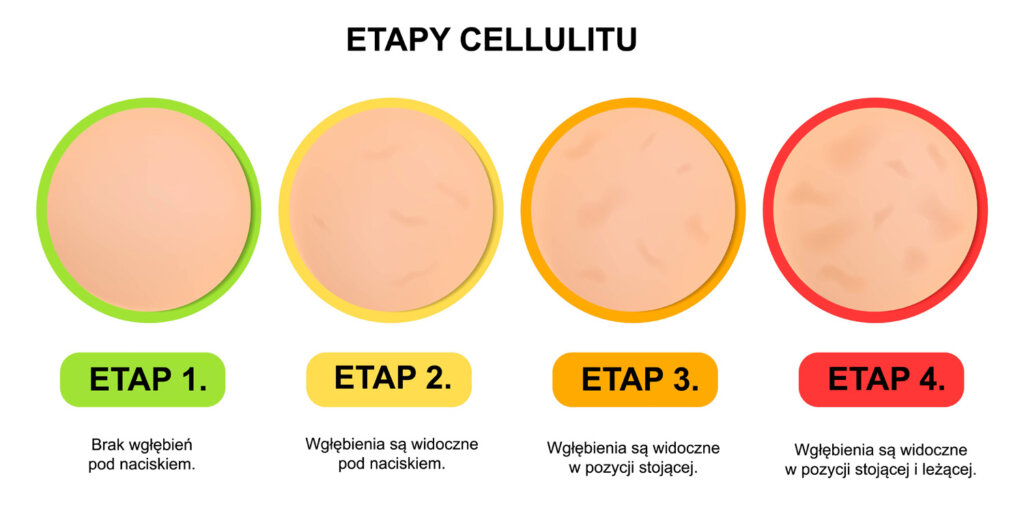
Stages of cellulite
Stage I. Mild cellulite is characterised by the absence of indentations when pressure is applied to the skin. However, lesions already appear due to stagnation of interstitial fluid. The fluid compresses the lymphatic vessels, causing impaired lymphatic outflow, which is manifested by the appearance of a small local swelling.
Stage II. In the skin, indentations are only formed under pressure. The reticulated connective tissue fibres located around the adipocytes impede blood and lymph circulation at the level of the capillaries. More and more visible swelling forms. The lymphatic system in the affected area only functions at 30-40% of its potential.
Stage III. Solid indentations are visible when standing and muscle tension, but not yet when lying down. This is the micro-tumour stage already with pronounced ‘orange peel’ symptoms.
Stage IV. The dimples are visible when standing or lying down. The fatty lumps enlarge to form macro-globules, which can be painful. The skin is visibly undulating. This form of cellulite is quite painful.
There are two types of cellulite:
- hard cellulite, or water cellulite
- soft, fatty (lipid) cellulite, found in inactive people who have lost weight
Cellulite prevention
Both the fight and prevention of cellulite are based on three pillars:
- regular physical activity i.e. sport, gymnastics, walking
- correct nutrition, well-chosen diet, exclusion of harmful products
- and last but not least, proper skin care of the body
The treatment of cellulite should be aetiopathogenetic, complex and gradual, affecting all stages of the process.
Cellulite reduction treatments: Thermo-Modelling + Thermo-Spherix® laser
The Thermo-Spherix® laser lipolysis method with pulsed magnetic field is an excellent alternative to anti-cellulite surgical procedures. It effectively reduces cellulite and local fat accumulation with simultaneous firming of the body skin. The energy of 940nm and/or 1200nm IR lasers is directed precisely at fat cells – adipocytes, without damaging the surrounding tissues. The accumulated energy produces a thermal effect causing fat liquefaction (breakdown of triglycerides into free fatty acids and glycerol). Red laser 650nm stimulates circulation, stimulates renewal and, at the same time, temporarily opens cell membranes allowing the removal of liquefied fat. Pulsating magnetic field increases the temperature of the tissues treated, increasing the efficiency of the treatment. It improves blood and lymph fluid circulation so that dissolved fat is rapidly metabolised, significantly improves skin quality by increasing collagen and elastin synthesis and accelerating cell metabolism. As a result, the skin is firmer and more elastic. After the thermo-modelling treatment, a drainage massage is performed to promote the body’s removal of fat. Thermo-active skin modelling preparations with a unique rich active base of slimming, anti-cellulite and firming formulas are recommended to maximise and accelerate results. They are dedicated to treatments with temperatures up to 70° C. Treatment frequency: 4-6 treatments in a series of 1 per week or as a stand-alone treatment.
Cellulite reduction during home care
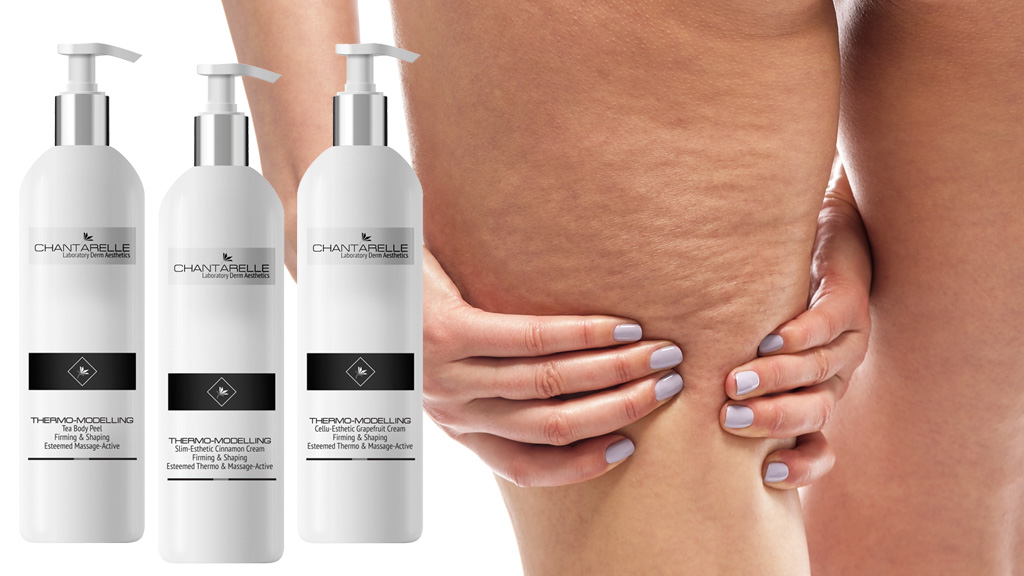
Home care is extremely important in the fight against cellulite. Improving blood circulation is an important preliminary step before the application of active ingredients. Therefore, a scrub and an active cream designed for skin with cellulite should be used during home care. Peeling helps to improve blood circulation and increase the penetration of active ingredients. The anti-cellulite cream moisturises the skin and reduces the appearance of ‘orange peel’. For the best home care, we recommend a 4-step home treatment: Step 1. On dry skin, perform a massage with a special brush. Step 2. Take shower and wash off the flaky cells of the stratum corneum. Step 3. Apply Tea Peeling from the Thermo-Modelling line to damp skin and massage the body parts affected by cellulite for 5. Massage the problem areas with circular movements – this method is excellent for improving blood circulation and maintaining skin firmness. A well-executed massage improves lymphatic drainage very well, which will significantly reduce the symptoms of cellulite. Step 4. Apply Anticellulite Grapefruit Cream, the ingredients of which will penetrate the skin more easily, thanks to the previous massages.
 dr Khrystyna Shekhovtsova
Chantarelle expert, dermatologist and aesthetic physician