Try our novelties and bestsellers!»





Active ingredients in cosmetics, Cosmetic treatments, Aesthetic cosmetology
Chantarelle professional chemical peels
Oct
Peeling (English. peel) to ogólna nazwa kilku metod (chemicznej, fizycznej, mechanicalej), involvingej partial or complete removal of the stratum corneum, as well as the layers underlying the epidermis, in order to initiate skin renewal processes.
A chemical peel treatment involves the application of a chemical substance to the skin to induce controlled skin damage through chemical reactions. The active ingredients of the peel penetrate to different depths and affect the skin structure in different ways. With the exception of retinol, all peelling agents used today work by damaging the skin – destroying their target directly or interfering with its function.
Factors affecting the degree of skin damage during peeling
1. The chemical nature of the peeling agent
2. Concentration of the peeling agent.
3. Concentration of the peeling agent.
4. The pH of the preparation used.
5. Carrier, i.e. the substance contained in the peeling preparation that affects the rate of penetration of the peel through the stratum corneum.
6. Exposure time.
7. Baseline condition of the skin to which the peeling preparation is applied.
Peelings by depth of action in the skin
-
-
- Pre-peel – accelerates the exfoliation of the most superficial keratinised scales. Often carried out as the first preparatory step for a cosmetic procedure.
- Superficial peeling – action at the level of the stratum corneum.
- Peeling medium-depth – action at the level of the stratum granulosum of the epidermis.
- Deep peeling – action at the level of the basal layer of the epidermis.
- Peeling very deep – action in the skin leading to the removal of the epidermis, part of the growth zone and the upper layers of the dermis reaching deep into the epidermis.
-
Chantarelle offers a wide range of classic and modern chemical peels with acids for different skin types. Chantarelle chemical peels are tolerated by the skin and produce clear results.
Chantarelle chemical peel system
| Mono-acids | Acid mix | PDT laser peels | Acid masks | Other peels |
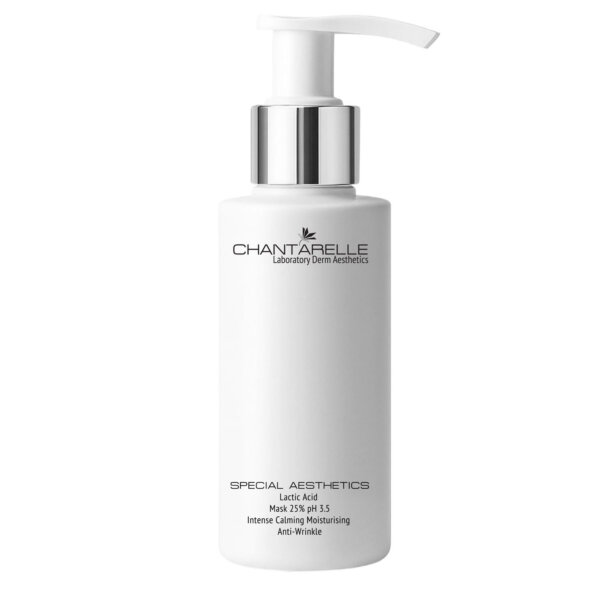
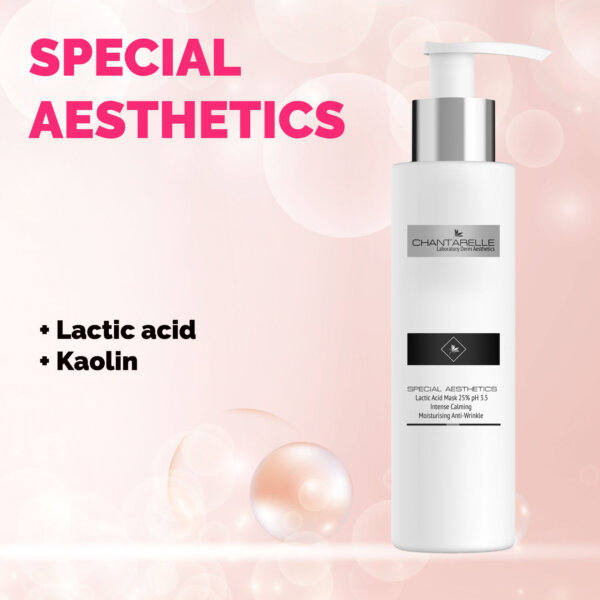
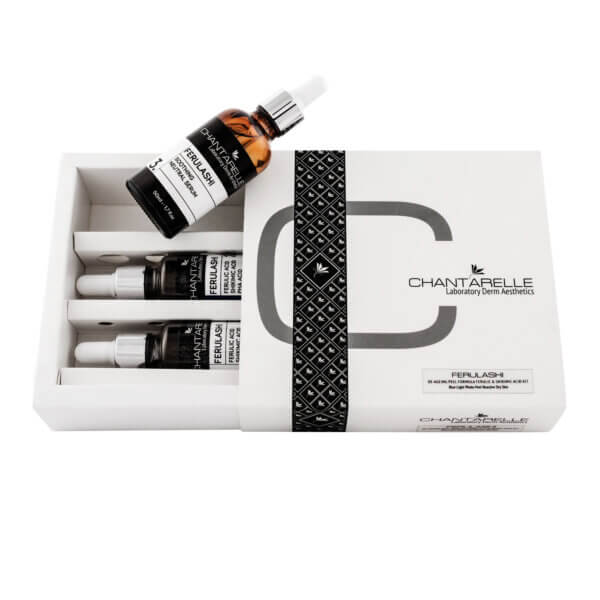
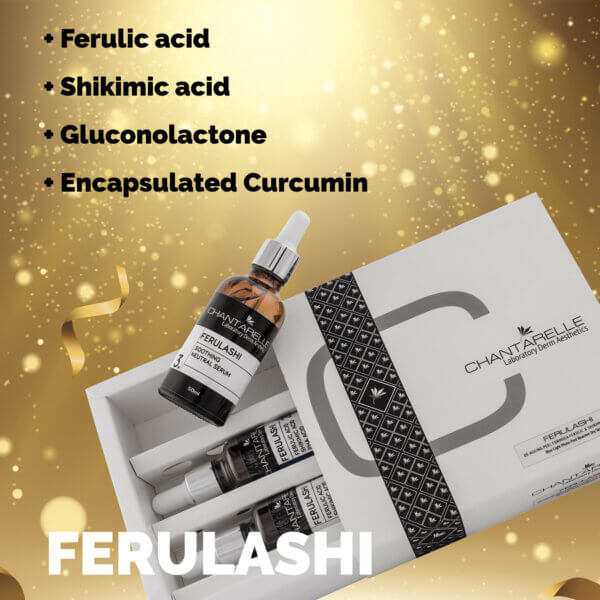
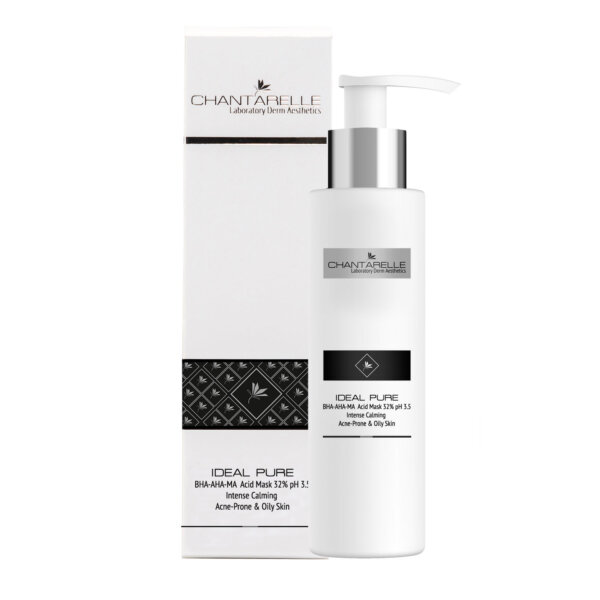
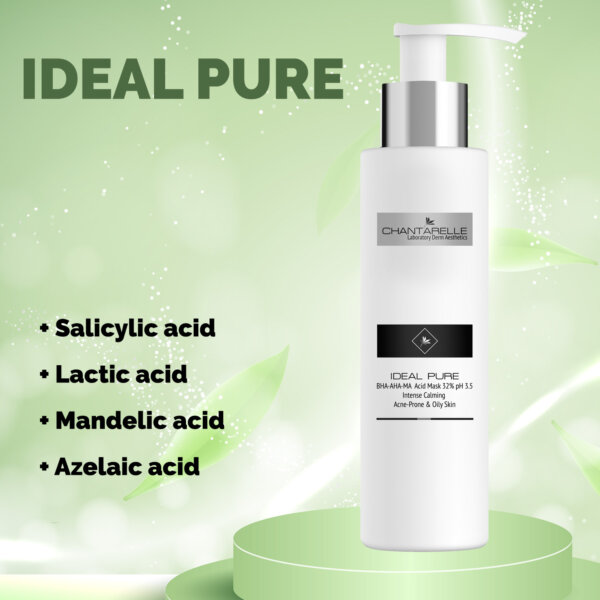
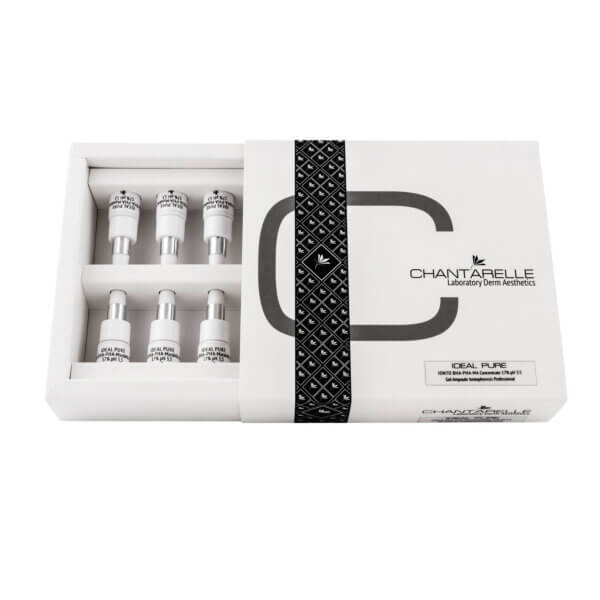
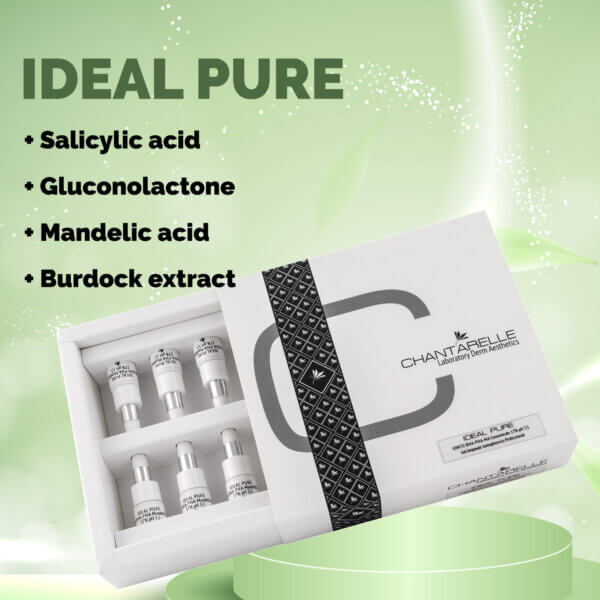
| M-acid lactic acid 30% рН 3,5 40% рН 3,5 20% рН 1,7 40% рН 1,6 55% рН 0,9 80% рН 0,3M-acid azelaic acid 40% рН 2,8 M-kwas ferulic acid 40% рН 2,2 50% рН 1,8 M-kwas lactobionic acid 50% рН 1,8 M-kwas citric acid 55% рН 0,3 M-kwas mandelic acid 40% рН 1,5 | M-acid glycolic acid lactic acid 40% рН 1,6 70% рН 0.5M-acid kojic acid lactic acid 25% рН 1,6 M-kwas lactic acid mandelic acid 33% рН 1,4 55% pH 0.7 M-kwas kojic acid citric acid 50% рН 1.7 M-kwas pyruvic acid lactic acid mandelic acid glycolic acid 50% pH 1.6 55% рН 1,5 65% рН 1,3 Ideal Pure salicylic acid gluconolactone 20% рН 3,5% Red Stop . lactobionic acid, azelaic acid, gluconolactone 10% pH 4.5 Red Stop . lactobionic acid, azelaic acid, gluconolactone 25% pH 3.5 | Exo Lift. PDT Lifting R peeling phytic acid 10% pH 5.0Platinum Peel&Cure . PDT Photodynamic Blend-Peeling Melaner 46% pH 3.0 Platinum Peel&Cure . PDT Photodynamic Blend-Peeling Retinologic 45% pH 3.0 Platinum Peel&Cure . PDT Photodynamic Blend-Peeling Sensiter 45.5% pH 3.2 Platinum Peel&Cure . PDT Photodynamic Blend-Peeling Age Clinic 52% pH 3.2 Superior Youth Boost. PDT Boost-Serum with microencapsulated pure retinol 0.3 Retinocal Pure PDT UV Photodynamic treatment kit against acne symptoms Ferulashi PDT UV Photodynamic treatment kit with ferulic and shikimic acid Absolute Rich Moisture. PDT Absolute Hydrating Peptide Peel Booster without acids | Ideal Pure. Salicylic acid lactic and mandelic acid 32% mask pH 3.5Special Aesthetics Lactic acid mask 25% pH 3.5 Special Aesthetics Lactic acid mask 25% pH 3.4 | Special Aesthetics Lumi-Enzymatic peeling cream Special Aesthetics Lumi-Gel enzyme peeling creamSpecial Aesthetics Silver-Derma Plus microdermabrasion cream 44% with sapphire powder Agemelan Holistic . Enzyme peeling pH 4.5 with ascorbic acid Agemelan Holistic . Granular peeling pH 4.5 with ascorbic acid Sebumelan Holistic . Enzymatic peeling pH 4.5 with citric acid Sebumelan Holistic . Granular peeling pH 4.5 with citric acid Platinum Peel&Cure . Foaming peeling 18% pH 4.5 Regenevia DNA . EPS Antioxidant peeling for the face and around the eyes Thermo-Modelling Tea body scrub |
What effect do the selected chemical peels have?
-
-
- Peeling with AHA acids – the skin acquires an even colour, the synthesis of protein fibres responsible for the youthfulness of the skin (collagen and elastin) and hyaluronic acid is stimulated, the level of hydration is increased, individual skin problems (hyperpigmentation, acne, dryness, age-related changes, etc.)
are eliminated.
- Peeling with salicylic acid – works to reduce symptoms of acne vulgaris. Cleanses the skin of blackheads, normalises sebum production by the sebaceous glands.
- Peeling with retinoic acid – smooths wrinkles and furrows, has a pronounced rejuvenating effect.
- Ezyme peeling – works very superficially at the level of the stratum corneum. Brightens skin tone, helps regulate the keratinisation cycle.
- Peptide peeling – suitable for the most demanding skin with a damaged bilayer. Also suitable for regular use on the skin around the eyes.
-
Types of chemical peels and their characteristics
-
- Monopeeling is a peel with a single acid, which the cosmetologist tailors to the needs of the skin in question for the correction of individual problems and structural imperfections.
- Peeling combined – in such a treatment, a composition of different chemical components is used, and thanks to them, a multi-level and synergistic effect is achieved.
- Peeling laser PDT – a modern peel containing special photosensitive ingredients for the symbiosis of photodynamic therapy with the active acid formula. Penetration of the peel is multilevel, the laser effectively helps to absorb the peel ingredients.
- Ppeelinga maskawith acids – gives a gentle acidity, it is used as an exfoliant for reactive, sensitive skin or as a preparatory step before the application of the next peel.
Layer acid treatments with Chantarelle
The experts at Chantarelle have developed layered acid application procedures for better tolerance and more natural results for the skin. The driving force behind the action of AHA and PHA acid peels is the change in their pH during treatment. The more the pH changes and the longer a given peel layer is kept on the skin, the stronger the exfoliating effect will be. Therefore, the strength of the peel depends on the pH of the preparation and the exposure time of the individual layers. This approach also allows us to control the course of the treatment and select the best peeling procedure individually. The layered treatments also allow us to supervise the gradual lowering of the skin’s pH. This allows us to control the safe concentration of acids and the reaction of the skin, which adapts more easily to the subsequent peeling stages. Today’s chemical peels used in beauty salons are no longer as aggressive as they used to be, and their variety makes it possible to solve most skin problems. That is why they can be called a universal, broad-spectrum agent.
 dr Khrystyna Shekhovtsova
Chantarelle expert, dermatologist and aesthetic physician
Chantarelle chemical peels