Try our novelties and bestsellers!»






Dermatology, Skin care at home, Tips
Stretch marks – how to recognise and combat them?
Nov
Stretch marks are more common on various areas of the female body, but they can also occur in men. The cause of their appearance is a rapid increase in skin tone over a short period of time, e.g. due to pregnancy or weight gain. It is estimated that stretch marks occur in 70% of teenage girls and between 50% and 90% of women during or after pregnancy.
Location of stretch marks
Stretch marks appear in any area of the body, but especially in those areas where there is subcutaneous fat. Therefore, the most common locations are the chest, abdomen, armpits, shoulders, hips, back and buttocks.
The appearance of stretch marks
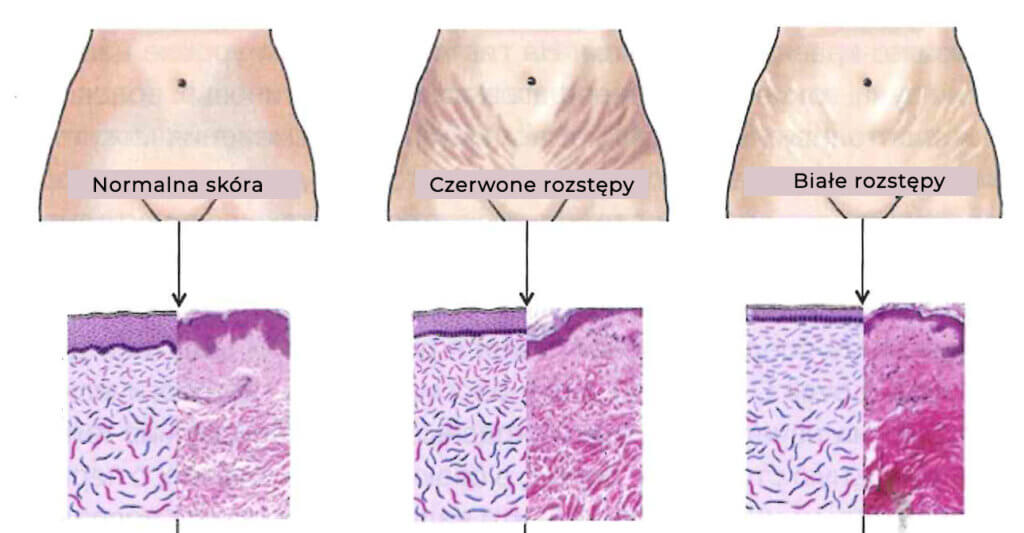
Stretch marks are common skin lesions that are visible as linear bands of wrinkled or atrophic skin. Thus, they look like cut-off strips on the skin and change colour over time. They gradually increase in length and width, become bluish-purple and eventually discolour. This is because initially there are still blood vessels inside the stretch marks, which is why the stretch marks are initially such a distinct red colour. Then the blood supply in the stretch mark area stops, the vessels become empty, the resulting skin loss fills in with connective tissue and the stretch marks turn white. On tanned skin, they are more visible because they remain white. Histological and biochemical analyses indicate that stretch marks are characterised by:
- thin epidermis,
- loss of the papillae of the dermis,
- flattening of the dermal-epidermal junction,
- reduction of extracellular matrix components such as collagen, elastin or fibrillin
In addition, with stretch marks, the collagen filaments are thinner and less numerous and the elastic fibres are aligned parallel to the epidermis. For this reason, stretch marks often look like atrophic scars. The disruption and loss of skin structure caused by mechanical overstretching is due to the inability of local fibroblasts to repair and replace damaged fragments of the extracellular matrix.
Hypotheses of stretch mark formation
Why does it happen? There are several reasons for the appearance of stretch marks, including:
- Gaining weight – however, it is not so much the number of kilograms that matters, but how quickly women and men have gained weight: the faster, the greater the risk of stretch marks.
- Hormonal imbalance and hormonal changes – during pregnancy, for example, the amount of oestrogen and cortisol decreases, which causes the synthesis of skin and connective tissue proteins – collagen and elastin – to be affected. With the help of these proteins, our skin can stretch well and restore its elasticity. If there is not enough collagen and elastin, the skin becomes brittle and thins faster, eventually cracking in some places and then scars (stretch marks) form in the areas of the tear.
- Mechanical skin stretching
- Inherited defects in skin structure
Factors contributing to stretch marks
| Background to the appearance of stretch marks | Factors |
| Pathological conditions | Cushing’s syndrome Rheumatism Chronic liver disease Obesity |
| Surgical factors | Augmentation mammoplasty Skin tension conditions after surgical procedures Skin suturing Organ transplantation, cardiac surgery |
| Medications | Systemic and topical corticosteroids HIV therapy Chemotherapy Contraceptives Antipsychotics |
| Other factors | Pregnancy Puberty Professional sports and strength training |
Types of stretch marks
There are therefore two forms of stretch marks identified clinically and histopathologically:
-
Acute phase – red striae (striae rubrae)
* Clinical features: long red streaks may be accompanied by itching, burning and soreness. ** Histological features:
-
- epidermis has a virtually normal structure
- dermis:
dermis.
- swelling (signs of inflammation), structural changes in collagen and elastin fibres become thinner, increased blood flow in microcirculation (causes red colour)
Chronic phase – white striae (striae albae)

Stretch mark prevention
- Be mindful of your diet, try not to gain weight drastically
- Make sure you moisturise and nourish your skin daily, not only on your abdomen and chest, but also on your hips, buttocks and legs
- Bring an active lifestyle: walk outdoors, play sports, swim
- Take alternating cold/warm showers, give massages
- Wear suitable underwear; a maternity bra is especially necessary for pregnant women with large breasts
- Regularly carry out well-chosen cosmetic treatments and apply home care for the prevention of stretch marks
Stretch mark therapy aims to achieve multiple effects
| Effect | Red stretch marks | White stretch marks | Active ingredients |
| Anti-inflammatory and anti-edematous activity | + | – | blue bio-retinol plant extracts of ivy, mugwort, ruscus, candelabra, ginseng, cat’s claw |
| Induction of collagen production in the skin and increased synthetic activity of fibroblasts | + | + | Regestril Stretch-Stop blue bio-retinol high molecular weight hyaluronic acid (1 MDa) |
| Reduction of skin irregularities | + | + | Regestril Stretch-Stop glycolic acid blue bio-retinol |
| Increased pigmentation | – | + | niacinamide glycolic acid |
| Reduction of inflammation | + | – | blue bio-retinol niacinamide squalane |
| Increase in the intensity of blood circulation | – | + | niacinamide hydrolysed collagen and elastin Stretch-Stop |
| Activation of cell proliferation | + | + | Regestril Stretch-Stop glycolic acid blue bio-retinol |
| Increase skin hydration | + | + | Regestril Squalane hydrolysed collagen and elastin high-molecular-weight hyaluronic acid (1 MDa) |
+ has meaning – not applicable
Changes in epidermal thickness
Histological and biochemical analyses showed that stretch marks are characterised by a thin epidermis due to flattening of the dermal-epidermal junction and a decrease in extracellular matrix components such as collagen, fibronectin. The reconstructed skin was stained with haematoxylin and eosin to measure epidermal thickness. (The red line in the figures below marks the boundary between the epidermis and the dermis.) As the use of drugs promotes skin remodelling in cases of atrophy, the study showed an increase in skin thickness compared to baseline.

 dr Khrystyna Shekhovtsova
Chantarelle expert, dermatologist and aesthetic physician